
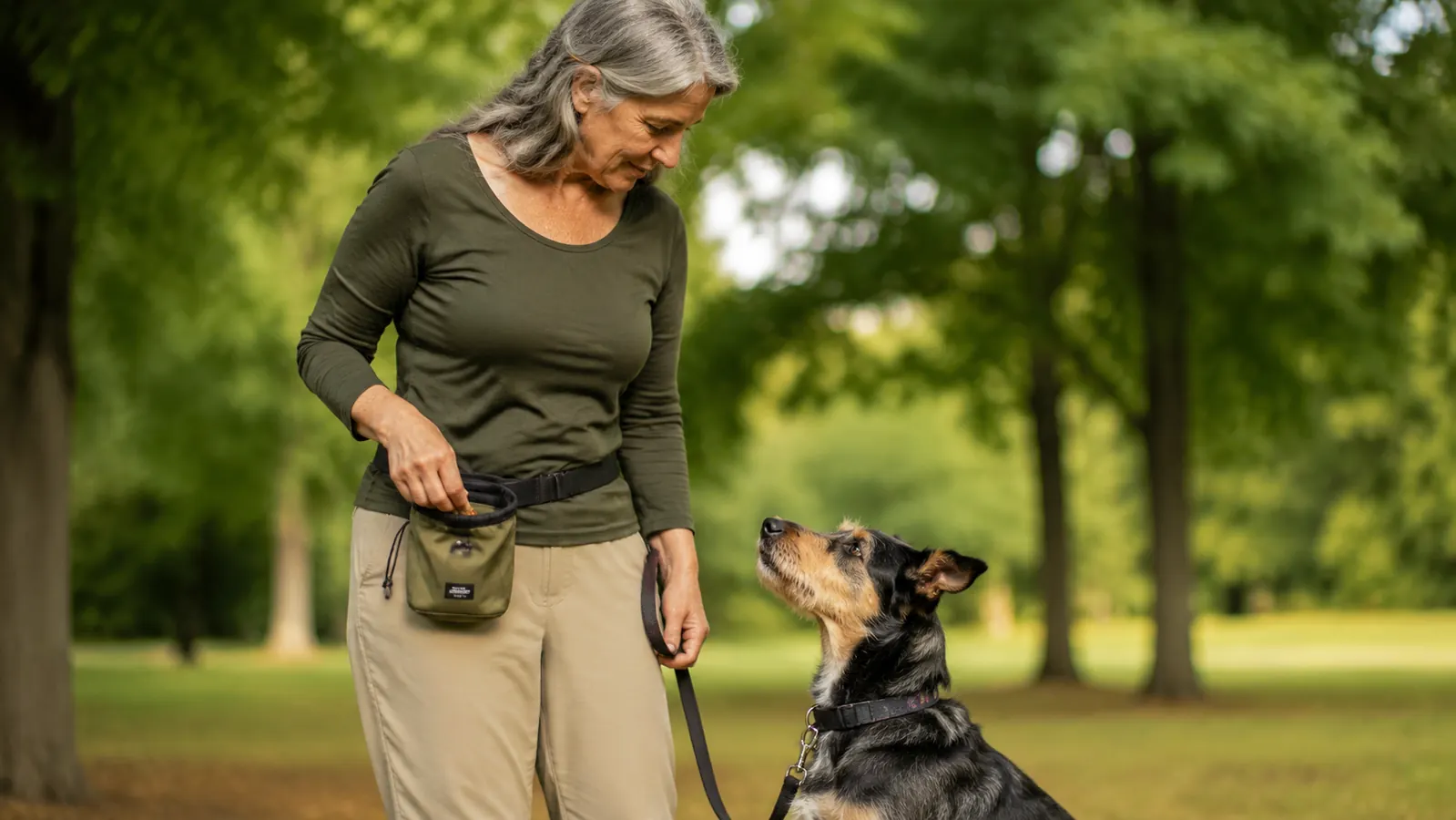
My rescue border collie mix, Finn, was 14 months old when I started structured training with him, and I quickly learned that fumbling through my jacket pocket for treats was burning the exact reward window I needed. By the time my fingers found a piece of kibble, Finn had already moved on to whatever smell was coming from three feet away. I needed something on my hip, open in under a second, and small enough that I didn't feel ridiculous wearing it to a busy park on a Saturday morning. I tried two cheap drawstring pouches from pet stores before a fellow trainer in my class mentioned the Gobeigo. I ordered it in March 2025. Six months and probably 250 sessions later, I have real opinions.
The Gobeigo treat pouch retails for around $16, ships with its own training clicker, and its signature feature is a two-flap magnetic closure instead of the roll-top or drawstring designs most pouches use. That sounds like a minor detail until you've worked a high-drive dog and realize that one-handed, eyes-forward treat access is not a convenience, it's a training necessity. Whether the magnet holds through mud, a washing machine, and six months of daily clip-and-unclip cycles is what this review is really about.
The Quick Verdict
A genuinely well-designed budget pouch. The magnetic closure earns its keep, the included clicker is better than expected, and it washes well. The belt clip loosens over time and the capacity is on the smaller side for giant breed owners.
Amazon Check Today's Price →Still using the same pocket trick? Your reward timing is probably 2 seconds off.
The Gobeigo treat pouch puts treats on your hip with a magnetic one-handed open. About $16 on Amazon, ships with a clicker.
Amazon Check Today's Price on Amazon →How I've Used It
Finn is a 42-pound mix, mostly border collie with some herding-breed unknown in the back half. He is fast, easily distracted, and extremely food-motivated when the treats are good enough. Our routine is a 30-minute morning session, Monday through Friday, in a neighborhood park with moderate foot traffic and the occasional off-leash dog disruption. Saturday sessions are longer, typically 60 to 90 minutes, and we work around higher distraction. We do recall, heel work, sit-stay, down-stay, leave-it, and lately some basic directional work. All of that happened with the Gobeigo clipped to my left hip, right side for the clicker, every single session.
I also used it twice weekly at a group training class from April through June 2025, where four dogs were working in close proximity and the pouch took some accidental brushes from other dogs and owners. I washed it in a mesh laundry bag with my regular clothes roughly every two weeks. Total wash count over six months: around 12 cycles in cold water, tumble-dry low. I mention this because durability reviews that don't account for laundry are missing half the story.
My treats of choice were small-cut pieces of chicken breast, freeze-dried beef liver, and standard kibble depending on session difficulty. The harder the distraction environment, the higher-value the treat. All three treat types behaved differently inside the pouch, and I'll cover what I noticed.
The Magnetic Closure: What Actually Happens Over Time
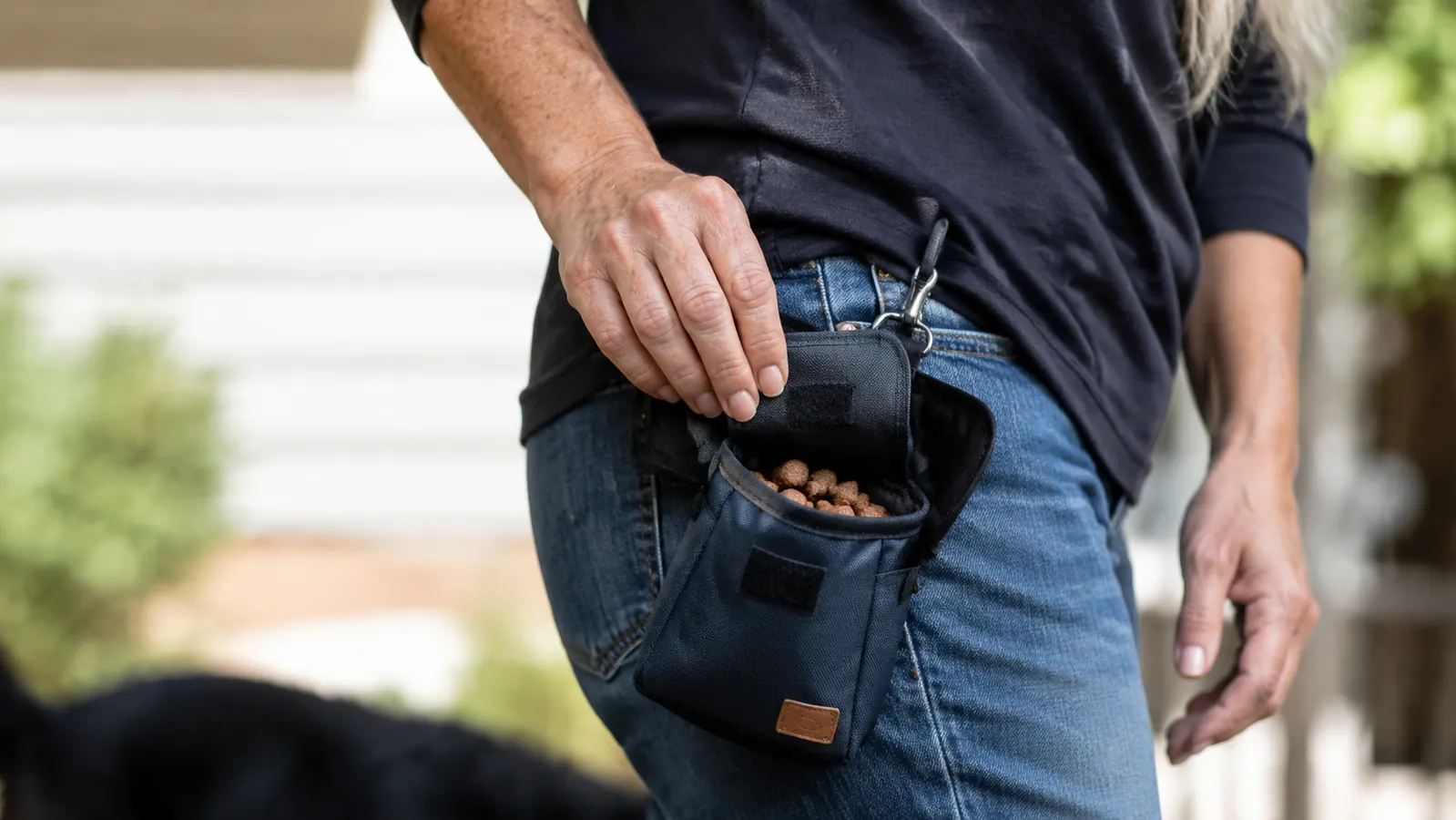
This is the main reason most people buy the Gobeigo over a cheaper alternative, so it deserves a thorough look. The two-flap magnetic closure works by pressing two small magnets together when you push the flap down. To open it, you press from the outside of the flap with your thumb and the pouch swings open into a stable open position. One hand. No looking down. This is genuinely useful and it works exactly as advertised in the first two months.
After about three months of daily use, I noticed the magnets were holding a little less firmly. The pouch didn't pop open spontaneously, but it no longer required that satisfying positive click to close. It had gone from 'definitely closed' to 'mostly closed.' On two occasions in month four, Finn bumped against my leg and the flap popped open, spilling about a tablespoon of kibble onto the ground. That has not happened with the more expensive Ruffwear Kibble Bag I now keep as a backup, which uses a drawstring that doesn't weaken with cycling. If you want a thorough side-by-side of the two, I put that together separately.
By month six, the magnetic closure is functional but softer than new. For casual trainers doing two or three sessions per week, this may never be an issue. For daily trainers with a high-energy dog, expect the closure to feel noticeably less positive around the four-month mark. It did not fail completely, and I kept using it, but I want to be accurate: six months of hard daily use does noticeably reduce the closure feel.
After three months of daily sessions, the magnets were holding a little less firmly. Not broken, but the confident click had gone quiet. For a twice-a-week trainer, this probably never matters.
Capacity, Treat Types, and the Smell Question
The product listing says approximately 2 cups capacity. In my experience, that's accurate when you're using dry kibble or small hard treats. Wet or semi-moist treats compress differently, and I'd estimate usable capacity with soft treats at closer to 1.5 cups. For a 40-pound dog doing 30-minute sessions, 1.5 cups of small treats is plenty. For a 90-pound Labrador working a full hour, you may find yourself refilling mid-session.
Wet treats like chicken pieces leave residue on the interior liner. The liner appears to be a smooth nylon or nylon-blend, and it does not absorb odors the way fabric pouches do. After 12 washes, there is a faint background smell of treats inside the pouch when you open it cold. That's not a complaint, that's just physics. What I will say is that it does not smell like a wet dog toy that's been left in a car, which is the failure mode on cheaper fabric-interior pouches. The smell is faint and food-appropriate.
One thing I did not anticipate: freeze-dried beef liver crumbles. Pieces break apart inside the pouch from normal movement, especially when jogging with Finn. By the end of a 60-minute session, there is a layer of powder-fine liver dust coating the interior. It washes out fine, but worth knowing if you use crumbly treats heavily.

The Belt Clip and Waist Fit
The clip is a standard spring-loaded belt clip, the same type you'd find on a phone holster or a carabiner-style keychain. New, it grips firmly. Around month three, I noticed it was gripping my belt less aggressively, and I had to check it before fast movements. By month five it had developed a habit of rotating 90 degrees on my belt during active sessions, which is annoying but not dangerous. The pouch never fell off, but it moved.
I wear a 1.5-inch belt and the clip is designed for belts in the 1- to 2-inch range. Fit was fine for me, but one person in my training class who wore a narrower 1-inch dress belt found the clip slightly loose from the start. If you're going to use this on running gear or athletic shorts with a thin waistband, thread the clip through a belt loop rather than just clipping over the waistband. It holds much more securely that way.
The pouch sits comfortably on the hip at rest and doesn't slap annoyingly during a brisk walk. During actual jogging it bounces slightly, which is noticeable but not bad enough to make me want a different carry option for those sessions.
The Included Clicker: Surprisingly Good
I expected the clicker that ships with the Gobeigo to be a throwaway piece of plastic, the kind that fails in two weeks. It didn't. The click is crisp and consistent, the sound level is appropriate for outdoor work without being harsh, and the wrist strap is a functional loop rather than a decorative one. After six months of use, the clicker still works exactly as it did on day one. It's not a professional training clicker with adjustable volume, and it's nothing like what you'd buy from a specialty trainer supply shop. But for everyday work, it's genuinely adequate, and its inclusion at a $16 price point is a real value-add.
I now keep the clicker that came with the Gobeigo as a spare and carry it during travel, since I don't worry about losing it. My main working clicker is a Terry Ryan Clik Stik I've had for two years, but the Gobeigo clicker is a reasonable entry point for new trainers figuring out whether clicker training is for them.
What I Liked
- Magnetic one-hand open works reliably for the first 3-4 months of daily use
- Included clicker is legitimately functional, not a gimmick
- Interior liner resists odor absorption better than fabric pouches
- Washes cleanly in a standard machine on cold with no shape distortion
- Low-profile hip fit, doesn't look absurd off the training field
- Price is hard to beat for the feature set, especially with the clicker included
Where It Falls Short
- Magnetic closure softens noticeably with 4+ months of daily use
- Belt clip loosens and rotates during high-motion sessions after several months
- 2-cup capacity is on the smaller end for large or giant breed owners
- Crumbly treats like freeze-dried liver leave significant interior residue
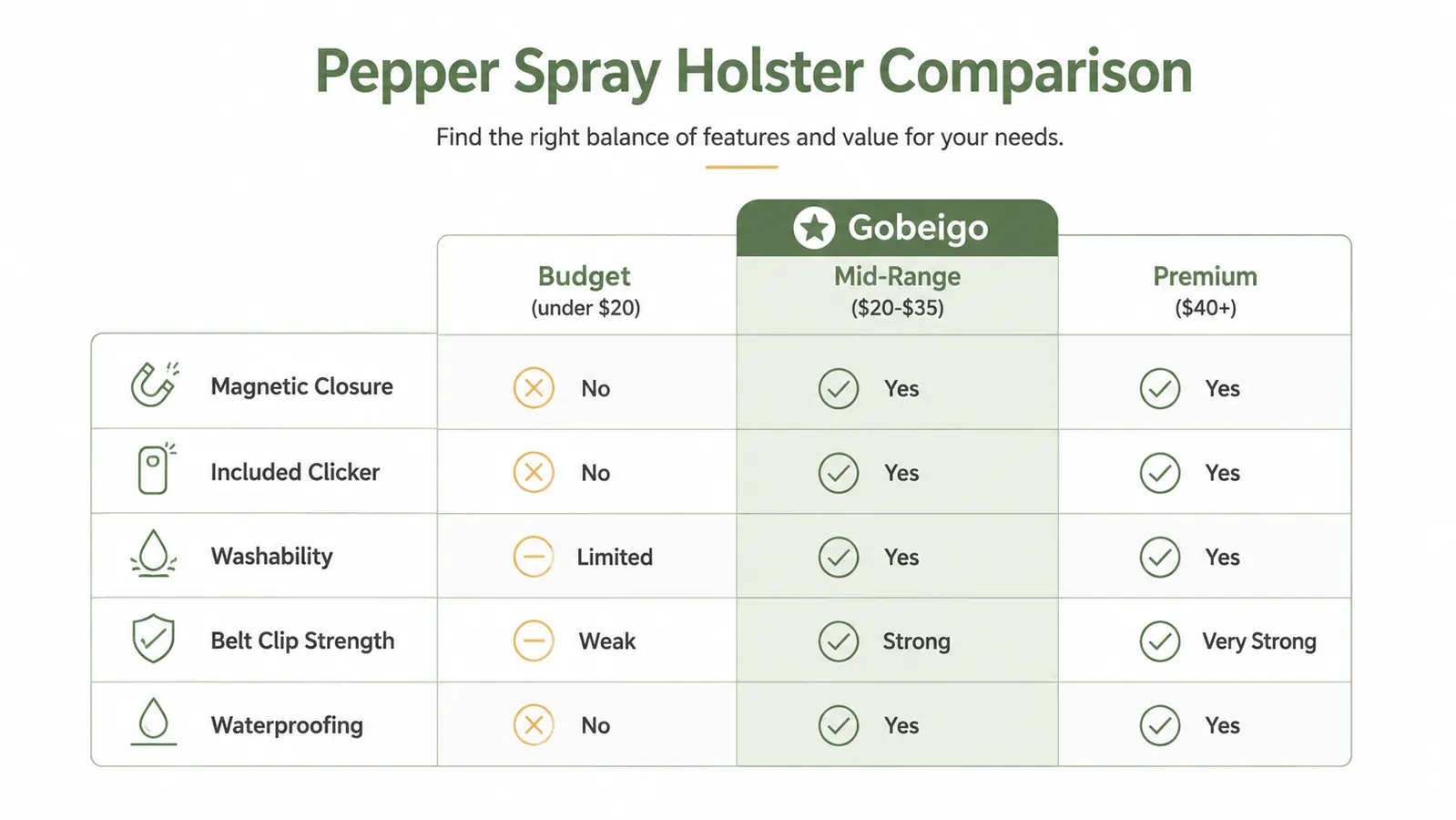
- No waterproofing on the exterior, which is a real issue in extended rain
Durability in Rain and Mud
Finn does not care about rain. I do, but he doesn't, so we train in it. The Gobeigo's exterior fabric is a standard ripstop nylon or similar, not coated or DWR-treated from what I can tell. In light rain, it holds up fine. In a genuine downpour, moisture seeps in through the seams around the opening after about 20 minutes. Dry kibble gets damp and softens, which isn't ideal but also isn't catastrophic. Soft treats fare worse because they absorb water and become nearly impossible to deliver quickly without leaving residue on your fingers.
For rainy-day training, I now keep the Gobeigo under my jacket or use a small ziplock of pre-counted treats inside the pouch as an added barrier. It's a minor workaround, not a dealbreaker at this price point. If you regularly train in wet conditions and don't want to improvise, the Ruffwear Kibble Bag's waterproof lining is genuinely worth the price difference. I wrote a full comparison of those two options if you want to see the side-by-side.
Who This Is For
The Gobeigo is the right choice if you're training a small to medium dog, working in mostly dry or mild conditions, and doing two to five sessions per week. It's also a strong pick for new trainers who want to try clicker training without buying a pouch and clicker separately. For that use case, it's an excellent value. Anyone who found their previous pouch was slow to open and cost them reward timing will immediately appreciate the magnetic closure in the first few sessions.
If you are heel training or working on a structured obedience protocol, this pouch supports that work well. The one-hand access means you keep your eyes on your dog and your treat delivery is fast enough to hit the mark. For a practical step-by-step framework using a treat pouch and clicker for heel work specifically, I put together a dedicated guide that walks through the full five-phase plan.
Who Should Skip It
If you train every single day with a large or high-drive dog and live somewhere rainy, the Gobeigo will start showing wear faster than you'd like. The magnetic closure degradation and clip loosening I experienced are both real, and they happen on the earlier side of the timeline for heavy users. You might also find the 2-cup capacity limiting if your dog needs higher treat volumes. In those cases, spending the extra money on a more robust design makes sense. The durability difference is real.
Owners who use crumbly treats predominantly, like freeze-dried raw toppers or soft training treats that break apart, should know the interior gets messy faster than it does with hard kibble or firm soft treats. It's washable, but if cleaning your gear frequently bothers you, factor that in.
If you're still losing reward windows digging in your pocket, this $16 fix is worth trying.
The Gobeigo treat pouch with magnetic closure and included clicker is the most value-dense starting point I've found at this price. Check current availability on Amazon.
Amazon Check Today's Price on Amazon →