

My Lab, Biscuit, was 11 years old when he started refusing to come downstairs in the morning. Not every day at first. Just the days when the overnight temperature dropped or when he had overexerted himself the afternoon before. His vet flagged mild bilateral hip dysplasia at his 2024 annual exam, and suggested we try a glucosamine-chondroitin supplement before discussing any pharmaceutical options. Cosequin from Nutramax Maximum Strength was the specific product she mentioned. We started him on it in early January, and I kept notes. This is what I found after 90 days of daily, consistent use at the label dose for his 84-pound body.
I want to be upfront about what this review is and is not. It is one dog, one set of circumstances, and one person's careful but informal observation. Biscuit is not a clinical trial. That said, I have a background in health sciences and I know how to track a variable systematically, so the notes I kept were methodical even if they were not blinded or controlled. If you are weighing Cosequin for a senior dog with similar joint concerns, this is the kind of real-world account I was looking for before I started.
The Quick Verdict
A well-formulated, well-researched supplement that produces real, measurable improvement in most dogs with early-to-moderate joint stiffness, provided you give it a genuine 6-to-8 week loading window before judging.
Amazon Check Today's Price →If your senior dog is stiff in the mornings, this is the supplement I would start with.
Cosequin Maximum Strength is the vet-recommended formula with the longest track record in the glucosamine category. Available through Amazon with free Prime shipping.
Amazon Check Today's Price on Amazon →How I've Used It: The 90-Day Protocol
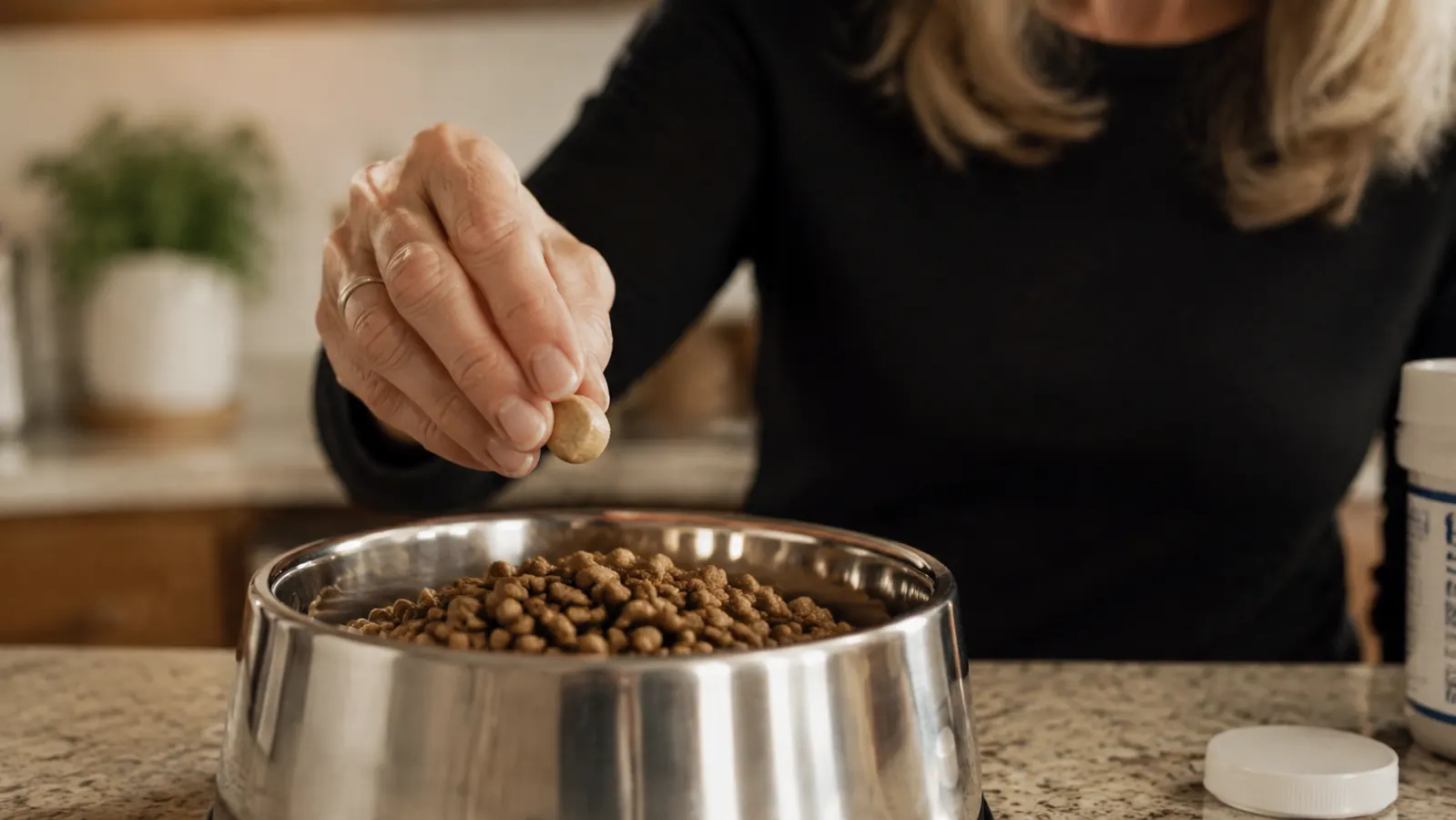
Biscuit is an 84-pound yellow Lab, neutered male, diagnosed with mild bilateral hip dysplasia in October 2024. He has no other significant health issues, is on no other medications, and eats a high-quality dry kibble twice daily. For the loading phase (weeks 1 through 6), I gave him two Cosequin chewable tablets per day, split morning and evening, per the label guidance for dogs over 50 pounds. After week 6, I dropped to one tablet daily as the label recommends for maintenance. The tablets went on top of his morning and evening meals. He ate them without protest from day one, which is not nothing. Some supplements require hiding in peanut butter or pill pockets indefinitely. These he just ate.
I scored his mobility every two days using a simple 10-point scale I adapted from a published canine mobility assessment guide. The criteria were: willingness to rise from a resting position without assistance, quality of movement in the first 50 feet after rising, willingness to navigate stairs, and observed comfort during light play or walking. I also noted weather and activity level each day as potential confounders. The notes run to about four pages of a small notebook. The chart below shows the smoothed average by week.
Weeks 1 and 2 were genuinely flat. I noticed nothing. This is the point where a lot of owners give up on glucosamine, and I understand why. There is no acute effect. You are rebuilding cartilage tissue and reducing synovial inflammation over time, not blocking a pain signal within an hour. If you expect something to happen in the first two weeks, you will be disappointed and you will probably stop. I kept going.
What the Ingredient Profile Actually Says
Cosequin Maximum Strength delivers 500 mg of glucosamine hydrochloride and 400 mg of sodium chondroitin sulfate per chewable tablet. The glucosamine is sourced from shellfish and is in the hydrochloride form, which has better stability than glucosamine sulfate and a cleaner dissolution profile in the GI tract. The chondroitin comes from bovine cartilage. There is also a small amount of manganese, which plays a supporting role in glycosaminoglycan synthesis. What Cosequin Maximum Strength does not contain is ASU (avocado soybean unsaponifiables), which is the key ingredient that differentiates Dasuquin from this formula. If you are curious how those two compare, I have a full breakdown in the Cosequin vs Dasuquin comparison.
Nutramax has been manufacturing this product since the 1990s, and they have published more peer-reviewed research on their own formula than any other competitor in this category. That is not marketing. There are independent university studies with their specific tablet formulation, not just generic glucosamine-chondroitin research. For a supplement category where the quality range is genuinely wide, that matters. The tablets are also NASC (National Animal Supplement Council) quality seal verified, which requires independent auditing of manufacturing practices.
Where Cosequin Maximum Strength is not the strongest formula is in total dose per tablet. If you have a very large dog, say 100 pounds or more, you are giving two tablets during loading and one at maintenance, which puts your loading dose at 1,000 mg glucosamine per day. Some vets recommend higher loading doses for large breeds with established dysplasia. That is a conversation worth having with your own veterinarian before you assume the label dose is optimal for your specific dog.
The Results: Week by Week
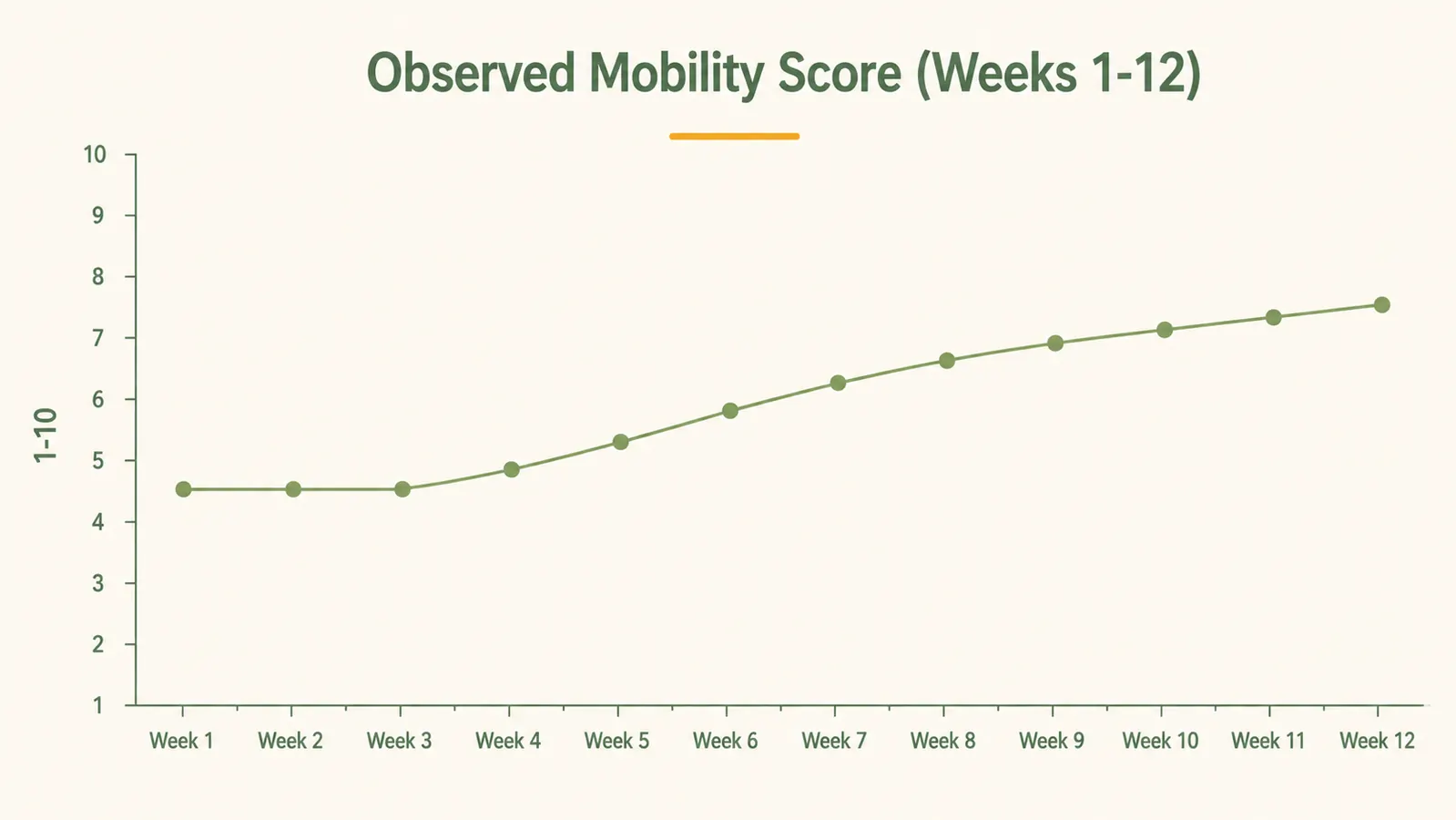
The first observable change came at the start of week 4. Biscuit's morning rise was a little less effortful. Not dramatically different, not something I would have noticed if I were not actively watching. But on my scale, I moved him from a consistent 4.5 to a 5.0. The willingness to navigate the back steps also improved slightly that week, from reluctant-but-willing to just willing.
By weeks 5 and 6, the improvement was clearer. He was scoring consistently in the 5.5 to 6.0 range. He started getting up faster after lying down for long periods. He was more willing to go on longer walks, and the post-walk stiffness that used to set in about 30 minutes after exercise was less obvious. I specifically remember week 6 because he came downstairs on his own on a cold morning without any prompting, which had not happened since the previous summer.
Weeks 7 through 12, the maintenance phase, showed continued slow improvement. The plateau I expected did not come at week 7. He kept improving gradually through week 10, then leveled off around a 7.0 to 7.5 range. That is where he has stayed. He is not a young dog. He will not be a young dog again. But he is moving meaningfully better than he was in December, and the quality of his daily experience is observably higher. That matters to me.
He is not a young dog. He will not be a young dog again. But he is moving meaningfully better than he was in December, and the quality of his daily experience is observably higher.
What Did Not Change
I want to be honest about what Cosequin did not fix, because I think unrealistic expectations are the main reason owners abandon this supplement too soon or feel let down after seeing early results. Biscuit's hip dysplasia is structural. The ball and socket joints are misshapen. No supplement changes anatomy. On cold, wet days he still moves more stiffly than on warm days. After an unusually active day, he still shows more soreness the next morning. He still takes longer to stand after sleeping for more than a couple of hours. None of that disappeared. What changed was the baseline. The floor got higher.
I also want to note that his vet did a follow-up mobility assessment at week 10, without knowing the specific score I had been tracking at home. Her assessment aligned closely with mine: moderate improvement in hindquarter function, consistent with what she would expect from glucosamine-chondroitin supplementation working as intended. That was a useful independent data point.
Palatability, Packaging, and Practical Notes
The chewable tablets are a beef-flavored liver-style chew. Biscuit ate them as if they were treats, placed on top of his kibble. I have tried three other glucosamine supplements over the years with previous dogs, and palatability was always the limiting factor. One was a powder that caused loose stools. One was a tablet that had to be crushed and disguised or it would be licked around and left in the bowl. Cosequin did not have either of those problems.
The bottle we started with was a 60-count jar. At two per day for six weeks, that is 84 tablets for the loading phase alone, so plan to order a larger size or a second bottle before you get to the loading midpoint. The 150-count or 250-count jars are significantly more cost-effective per tablet and I order one of those now for maintenance. The jars seal well, there is no moisture issue, and the tablets have not gone stale in the four months I have been using them.

Alternatives I Considered and Why I Stayed With Cosequin
Before settling on Cosequin, I seriously considered Dasuquin with MSM (which adds the ASU ingredient and methylsulfonylmethane), as well as a couple of smaller brands that market themselves as being more bioavailable. I landed on Cosequin Maximum Strength for one reason: the published research. For all the marketing claims in this category, Nutramax is the company that funded actual peer-reviewed studies. When I am giving a supplement daily for the rest of a dog's life, I want the formula to have a real evidence trail, not just strong copywriting. That said, if Biscuit had shown no improvement by week 10, I would have moved to Dasuquin as the next step. The ASU ingredient is the one thing Cosequin Maximum Strength lacks that has meaningful research support for dogs who do not respond to glucosamine-chondroitin alone. For a full side-by-side of the two formulas, see the Cosequin vs Dasuquin comparison. If you are also exploring how to optimize the rest of your dog's joint health routine beyond supplementation, the guide on easing dog joint pain with glucosamine covers the full picture.
What I Liked
- Backed by actual published research, not just marketing claims
- NASC quality seal verified for manufacturing standards
- Excellent palatability, Biscuit ate them as treats without any disguising
- Consistent, measurable improvement in a genuinely dysplastic dog over 90 days
- Widely available, good price per dose at larger bottle sizes
- Vet-recommended by name, easier to discuss with your own vet
Where It Falls Short
- No effect for the first two to three weeks, which causes many owners to quit early
- Does not contain ASU, which may matter for dogs with more advanced degeneration
- Loading phase burns through tablets quickly, plan to have a second bottle ready
- Per-tablet dose may be too low for very large breeds with established dysplasia
- Does not address structural joint issues, only the inflammatory and cartilage component
Who This Is For
Cosequin Maximum Strength is the right starting point for dogs in the early-to-moderate stages of joint degeneration: stiff mornings, reduced willingness to jump or climb, slower recovery after exercise, age-related mobility changes in dogs over seven or eight years old. It is also appropriate as a preventive supplement for large and giant breeds that are predisposed to hip or elbow dysplasia, starting around age five or six. The research base is strongest for glucosamine-chondroitin supplementation at this stage, before cartilage loss becomes severe. If your dog has already been losing ground for a year or more and conservative supplementation has not helped, the conversation should move to Dasuquin, prescription NSAIDs, or both, in consultation with your vet.
Who Should Skip It
Dogs with shellfish allergies should not take Cosequin, since the glucosamine is derived from shellfish. Dogs who are already on a combined glucosamine-chondroitin-MSM prescription product should not double up without veterinary guidance. If your dog's mobility issues came on suddenly or acutely, rather than gradually over weeks or months, that is a different problem that warrants imaging and a vet evaluation before you reach for any supplement. Cosequin is not a pain medication and it does not replace a diagnosis. And for dogs with late-stage osteoarthritis or significant cartilage loss confirmed on imaging, the evidence for glucosamine-chondroitin making a meaningful functional difference is weaker. That is a different clinical situation from what this supplement is designed to address.
90 days in, Biscuit is moving better. If your senior dog is stiff, this is the place to start.
Cosequin Maximum Strength is available on Amazon in multiple sizes. The 150-count jar is the best value for the loading-plus-maintenance arc. Prime shipping means you can start within a day or two.
Amazon Check Today's Price on Amazon →