

Over 56,000 Amazon reviews paint a pretty clear picture: this rake pulls hair. People love it. The star rating sits at 4.6 and has held there for years. If you stopped reading at the summary, you would probably just click buy and move on. But I kept digging, because the questions that actually matter to me as a pet owner are never the ones the aggregate score answers. Does it work on every coat type, or just the shaggy photogenic ones? What happens if you press too hard on a dog with thin skin? Which side do you start with, and does it actually matter? And what does it miss entirely? Those are the things I want to lay out clearly, because the Maxpower Planet rake is genuinely worth owning for a lot of people, but not everyone who buys it realizes what they are actually getting.
My household includes a nine-year-old Maine Coon named Priya and a four-year-old Shiloh Shepherd named Koda, both of whom shed in quantities that defy physics. I have used this rake on both of them across multiple shedding seasons, and I have watched enough first-timer attempts on Koda to know that the tool behaves differently depending on how you approach it. This review is about the part that comes after unboxing.
The Quick Verdict
An outstanding value for double-coated dogs in shed season, but the 9-tine dematting side requires more technique than the listing suggests, and sensitive-skinned or single-coated pets need a gentler hand.
Amazon Check Today's Price →If your floors are half undercoat, this is the tool that changes the math.
The Maxpower Planet rake is about $17 and is backed by more real-owner reviews than most grooming tools triple its price. Check the current price and see if it ships to you.
Amazon Check Today's Price on Amazon →What the Two Sides Actually Do (and Which Order Matters)
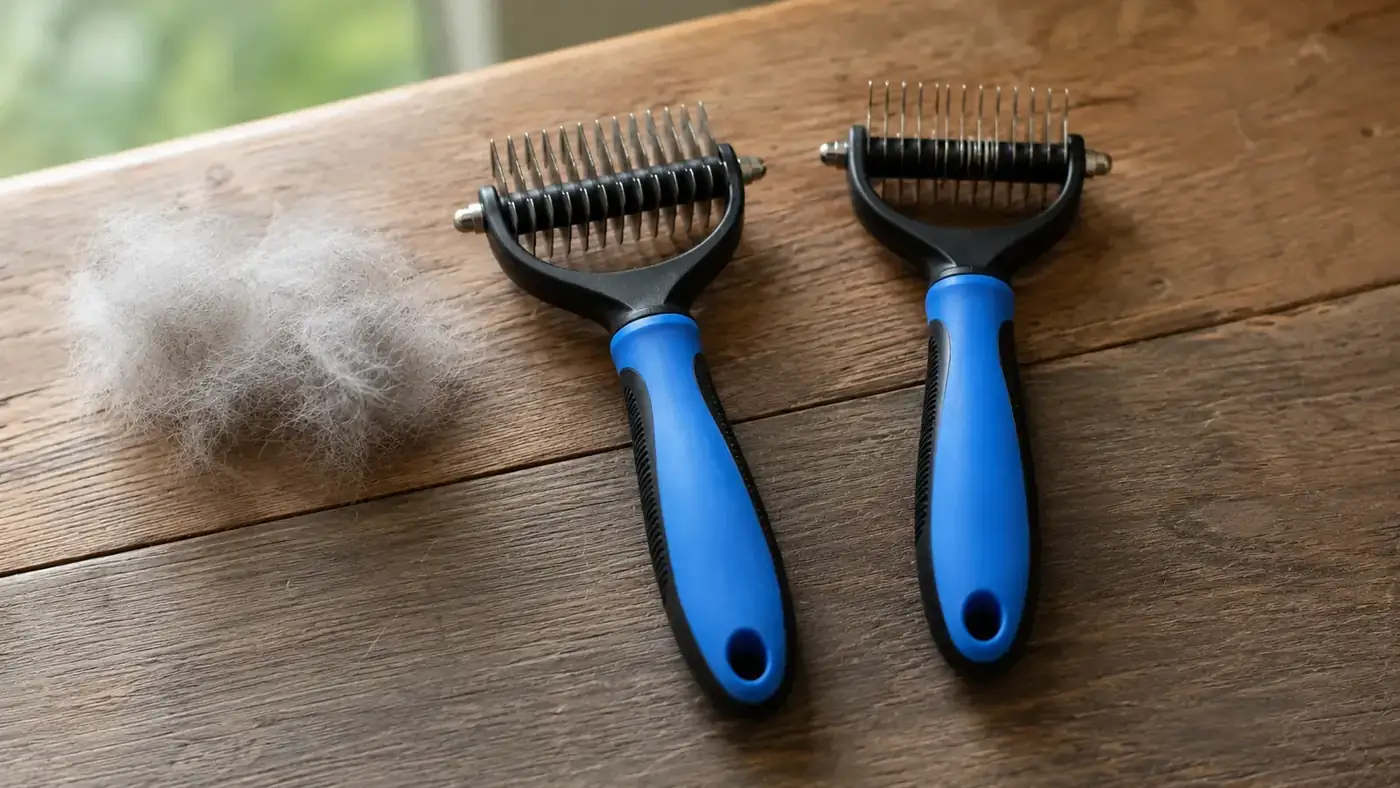
The listing describes this as a "double-sided" tool and leaves the explanation roughly there. In practice, the two sides serve genuinely different functions. The side with 17 finer, closely spaced tines is the deshedding side. It is designed to pull loose undercoat out of the guard hair layer without cutting anything. The side with 9 wider-spaced, slightly curved tines is the dematting side. It is designed to work through tangles, and it does so by cutting the mat open rather than pulling it free in one piece.
The order you use them matters more than most owners realize. If your dog has no mats, start with the 17-tine side across the whole coat to lift and remove loose fur. Then follow with a slicker brush if you want to finish. If your dog does have mats, start with the 9-tine side very carefully on the mat itself before switching to the 17-tine side for general deshedding. Using the 17-tine side on a matted area first will pull the mat tighter and can cause real discomfort. Several one-star reviews I read were almost certainly describing this exact mistake.
On Koda, a dog with a thick plush double coat and no mat history, I use the 17-tine side almost exclusively for our regular maintenance sessions. The 9-tine side comes out only after an unusually long gap between grooming or after he has been romping in tall grass. On Priya, whose fur actually does mat if I let more than two weeks go by without attention, the 9-tine side is the workhorse, and the 17-tine is the finisher.
The Coat Types It Works Best On (and the Ones to Be Careful With)
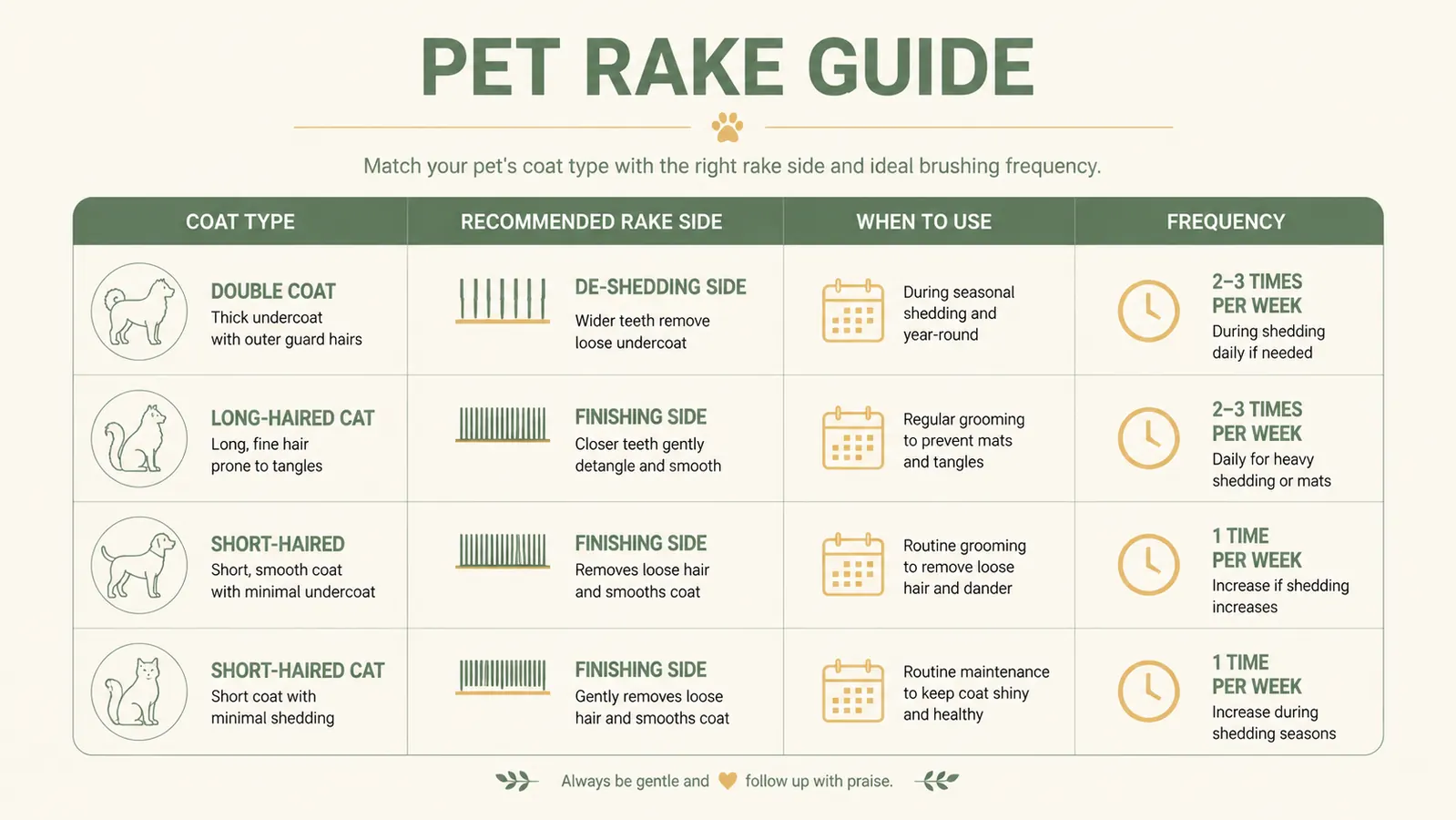
This rake performs best on dogs with dense double coats: Huskies, Shepherds, Malamutes, Samoyeds, Corgis, Chow Chows, Golden Retrievers, and similar. Those coats have a distinct undercoat layer that sits below the guard coat, and the tines on both sides of this rake are spaced to work in that space. After a few strokes on Koda, you can pull the rake off the coat and see a visible clump of loose undercoat caught in the tines. That is the feedback loop that makes the 56,000 reviews so enthusiastic.
Single-coated dogs, which include breeds like Poodles, Maltese, Portuguese Water Dogs, and most terriers, are a different story. Their coats are structurally different: there is no dense undercoat to harvest, just a single layer of hair. Using the 17-tine side on a single-coated dog with any real pressure can scratch the skin or break the hair unnecessarily. If you own a single-coated breed and you are buying this for deshedding, I would look at a different tool. If you are buying it for dematting on a single-coated dog, the 9-tine side is appropriate, but use short, careful strokes at the edge of the mat, never against the skin directly.
For cats, the calculus changes again. Priya, my Maine Coon, tolerates the 17-tine side on her flanks and haunches during peak spring shed, and it does pull a meaningful amount of loose undercoat. But I use a genuinely light touch. Cats have thinner, more reactive skin than most dogs, and many cats will signal discomfort before it becomes a problem, but not all of them will. Short sessions, light pressure, and ending on your cat's terms is the protocol that works. For short-haired cats, skip this rake entirely and use a rubber grooming glove instead.
The Technique Details the Listing Does Not Give You
The biggest mistake I see first-time users make is treating this like a hairbrush. A hairbrush, you drag from root to tip repeatedly in long strokes. The Maxpower rake works differently. You want to use a flicking motion at the end of each stroke, lifting the rake away from the coat rather than dragging it back toward you across the skin. That flicking motion is what releases the undercoat from the tines and what keeps you from dragging loose fur back over skin that has already been raked.
Pressure is the other thing nobody tells you. Light pressure, deliberately applied. The tines do the work, not your arm. If you press hard enough to see the skin through the coat on every stroke, you are using too much force, and you will have a sore dog by the end of the session. Koda is a stoic dog and will stand patiently through a lot of discomfort without signaling it, so I learned early to watch his skin rather than his expression.
Section the coat before you start. Work one panel at a time, the way a hairstylist clips up sections before cutting. On a big dog like Koda, I start at the hindquarters and work forward, finishing at the neck. Attempting to just drag the rake randomly across the whole dog misses patches and leaves you unsatisfied with the result. It also means you rake the same areas multiple times while leaving other areas untouched.
The tines do the work, not your arm. The moment you start pressing hard to get more hair, you are doing it wrong and your dog can feel it.
Build Quality: What Holds Up and What Is Just Adequate
At roughly $17, the Maxpower Planet rake is not a premium grooming tool, and it does not pretend to be. The handle is a lightweight plastic that feels fine in the hand but would not survive being sat on or dropped on concrete repeatedly. The tines on both sides are stainless steel, which matters for longevity and for not rusting in a humid grooming space. After more than two years of regular use, my tines have held their shape and sharpness, and I have not seen the bending or soft-tine complaints that surface with some cheaper rakes.
The ergonomics are functional rather than thoughtful. The handle is a straight grip without any rubber coating or finger grooves. For a five-minute touch-up, that is completely fine. For a 30-minute full-body deshedding session on a heavy-coated dog, your hand will notice the unpadded plastic. I keep a grooming glove nearby for the final pass specifically because my hand is tired by then. If you groom multiple dogs in a session, a handle with more grip support would genuinely be better.
The dual-sided design is secured by a simple molded plastic frame, and after extended use I have not seen any separation between the two sides or loosening of the tines. The cleaning process is straightforward: pull the caught fur off the tines with your fingers or tap the rake against the side of a trash can. There is no self-cleaning mechanism. That is standard for a rake at this price, but worth knowing if you are comparing it to tools with push-button hair-release systems.
What I Liked
- Outstanding undercoat removal on double-coated dogs, especially in shed season
- Two genuinely different functions on one tool -- deshedding tines and dematting tines
- Stainless steel tines have held up without bending or dulling over two-plus years of use
- Priced under $20, making it accessible even for owners on a tight pet-care budget
- Works well on medium to long-haired cats with the right light-touch technique
- Easy to clean between passes -- no mechanism to break, no batteries, no attachments
Where It Falls Short
- No usage instructions included -- the two-sides-serve-different-purposes distinction is not explained on the packaging
- Unpadded plastic handle becomes uncomfortable during long grooming sessions on large dogs
- Not appropriate for single-coated breeds as a deshedding tool -- can scratch skin or break hair
- Requires deliberate technique; aggressive or inexperienced use can cause discomfort
- No self-cleaning mechanism -- manual fur removal from tines after each pass
- Does not replace a slicker brush or finishing comb for full grooming -- it is one step in a routine, not a complete routine

What Nobody's Negative Review Is Actually Saying
When I read the critical reviews on this product, a pattern emerges that is not really a product failure. Most negative reviews fall into three categories. The first is technique complaints that describe using the 9-tine side like a deshedding tool and then being surprised the dog did not enjoy it. The second is coat-type mismatches, where owners of short-haired or single-coated dogs found the rake too aggressive. The third is expectation mismatches, where someone expected a single-pass miracle tool and found that consistent grooming sessions over time yield far better results than one intensive desperate attempt.
What I am not dismissing is this: if you have a dog with sensitive skin, a skin condition, or a thin single coat, the complaints about scratching are completely legitimate. The tines on the 17-tine side are fine enough that on the wrong coat type and with any real pressure, they can abrade skin. This is not a product defect. It is a tool being used on the wrong animal for the wrong job. But knowing that upfront would save a lot of people a frustrating first session.
How It Compares to FURminator Without the Fanfare
The FURminator is the other rake most people consider, and it costs three to four times more depending on the size you need. I have used both. For double-coated dogs in full-blown shed season, the difference in raw hair removal per session is smaller than the price difference suggests. The FURminator's ejector button is genuinely convenient. The stainless steel edge on some FURminator models does cut the undercoat as it passes through, which can be slightly more efficient on very dense coats. But the Maxpower's tines are blunt by design, meaning there is less risk of accidentally cutting guard coat if you lose your angle.
For most pet owners grooming at home, the Maxpower Planet rake delivers 80 to 90 percent of the FURminator's performance at 20 to 25 percent of the cost. The gap in performance widens at the extremes: a professional groomer running 12 sessions a day would want the more durable handle and the ejector mechanism. For a pet owner doing weekly maintenance on one or two animals, the Maxpower is the honest value choice. I own both and use the Maxpower more often.
Who This Is For
This rake is built for owners of double-coated dogs and medium-to-long-haired cats who want to seriously reduce the volume of hair leaving their pet's body and landing on their furniture. If you are doing weekly maintenance grooming, the 17-tine side alone will change how much hair accumulates between sessions. If your dog or cat occasionally picks up mats after outdoor adventures or between grooming appointments, the 9-tine side handles that without a trip to the groomer for most mild tangles. At under $20, it earns a place in the grooming kit even if it is not your only tool.
Who Should Skip It
If you own a short-haired dog, a smooth-coated breed, or a single-coated dog like a Poodle or Bichon Frise, this rake is not the right tool. A rubber grooming glove, a shedding blade, or a bristle brush will serve those coats far better without any risk of skin irritation. If your dog has active skin conditions, hot spots, or any areas of broken skin, do not use any grooming rake over those areas regardless of brand. And if you are not willing to take five minutes to learn the technique difference between the two sides, you will likely end up frustrated with a tool that works well for people who use it correctly.
If your dog has a double coat and you have not tried a grooming rake yet, this is where to start.
The Maxpower Planet double-sided rake has over 56,000 reviews for a reason. At the current price it is the lowest-risk grooming upgrade you can make for a heavy shedder. Worth checking what it ships for today.
Amazon Check Today's Price on Amazon →