

I want to be honest about something before I get into the specs: I almost wrote the standard pet camera review. The one where you describe the 2K resolution, call the treat tosser "a game-changer," paste in the star rating, and link to Amazon. I have read a dozen of those reviews. None of them told me what I actually needed to know before buying.
So here is the review I wish I had found. My dog is a five-year-old beagle mix named Clover, about 28 pounds, with the kind of separation anxiety that makes neighbors knock on my door. I bought the Furbo Mini 360 four months ago after trying two other cameras that I will get to later. This is what living with the device actually looks like, including the part where I sat at my kitchen table with my credit card open on the subscription page and had to make a real decision.
The Quick Verdict
Genuinely useful hardware let down by a subscription model that shifts real value behind a paywall. Worth it for separation-anxiety households who will use it daily. Overkill for occasional check-ins.
Amazon Check Today's Price →If Clover's story sounds like your dog, the Furbo Mini 360 is worth a look before you commit.
It is currently available on Amazon. Check the current price before deciding whether the subscription tier makes sense for your situation.
Amazon Check Today's Price on Amazon →How I Have Actually Used It
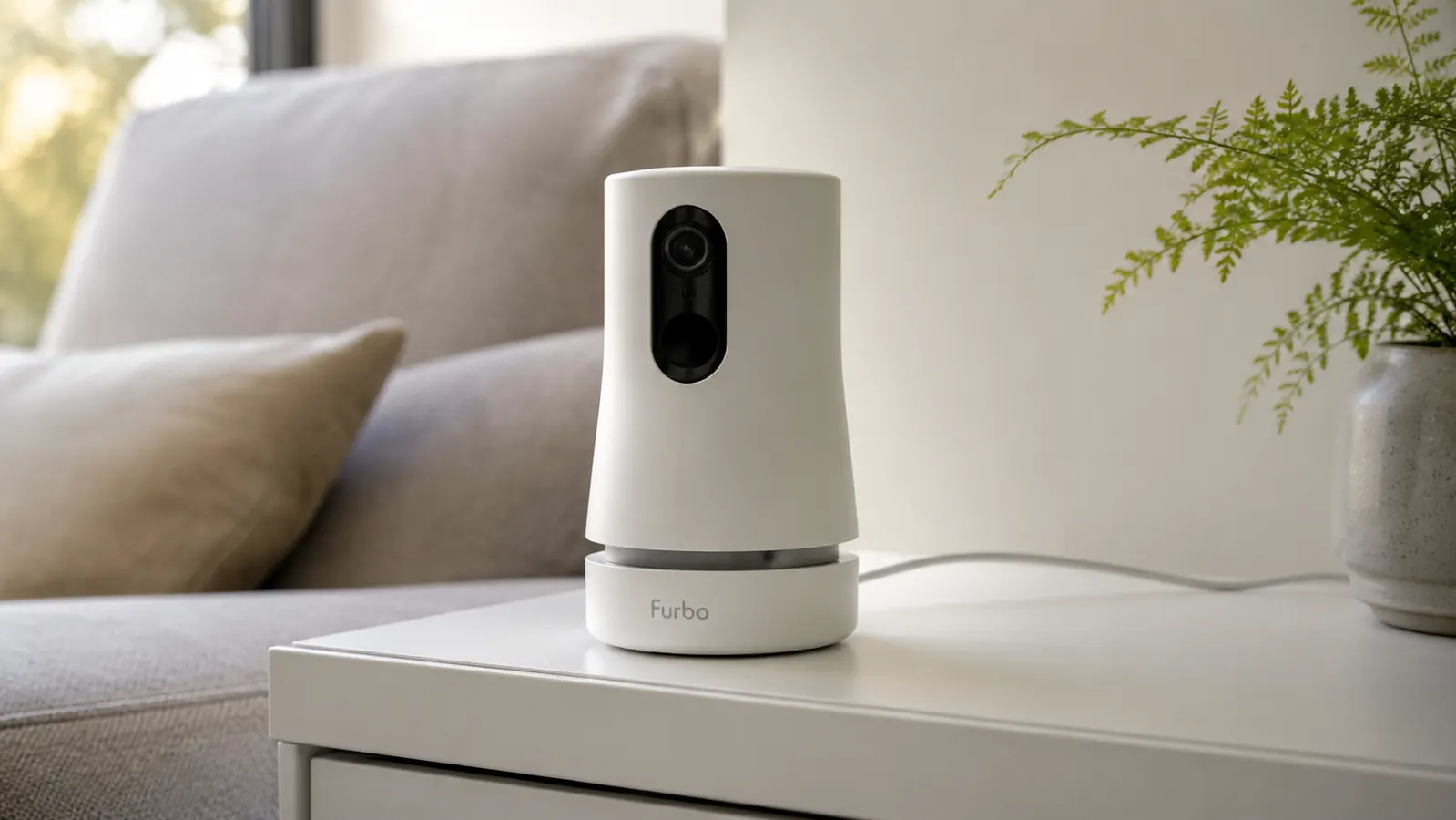
The Furbo Mini 360 lives on my living room bookshelf, about six feet off the ground, angled toward the main couch where Clover spends most of her day. I check the app an average of three to four times at work, usually around 9 a.m., noon, and right before I leave the office. On high-anxiety days, when I know Clover heard a thunderstorm moving in or got spooked by the building's fire-alarm test, I check more often.
The 360-degree pan is the feature I underestimated most. My previous camera was fixed-angle, and I was constantly wondering what was happening off-frame. With the Mini 360, I can sweep the room from my phone. It moves quietly enough that Clover does not immediately notice, which means I get genuine behavioral data rather than a dog who performs for the camera the moment she hears the motor.
I toss treats maybe once per session, not because the feature is unreliable but because I learned fairly quickly that too many treat rewards for doing nothing trains a dog to stare at the camera all day waiting. My vet behaviorist actually advised me to use the treat function specifically when Clover is calm and settled, to reinforce relaxed behavior rather than camera-attention-seeking.
The Subscription Question: What You Actually Get for Free
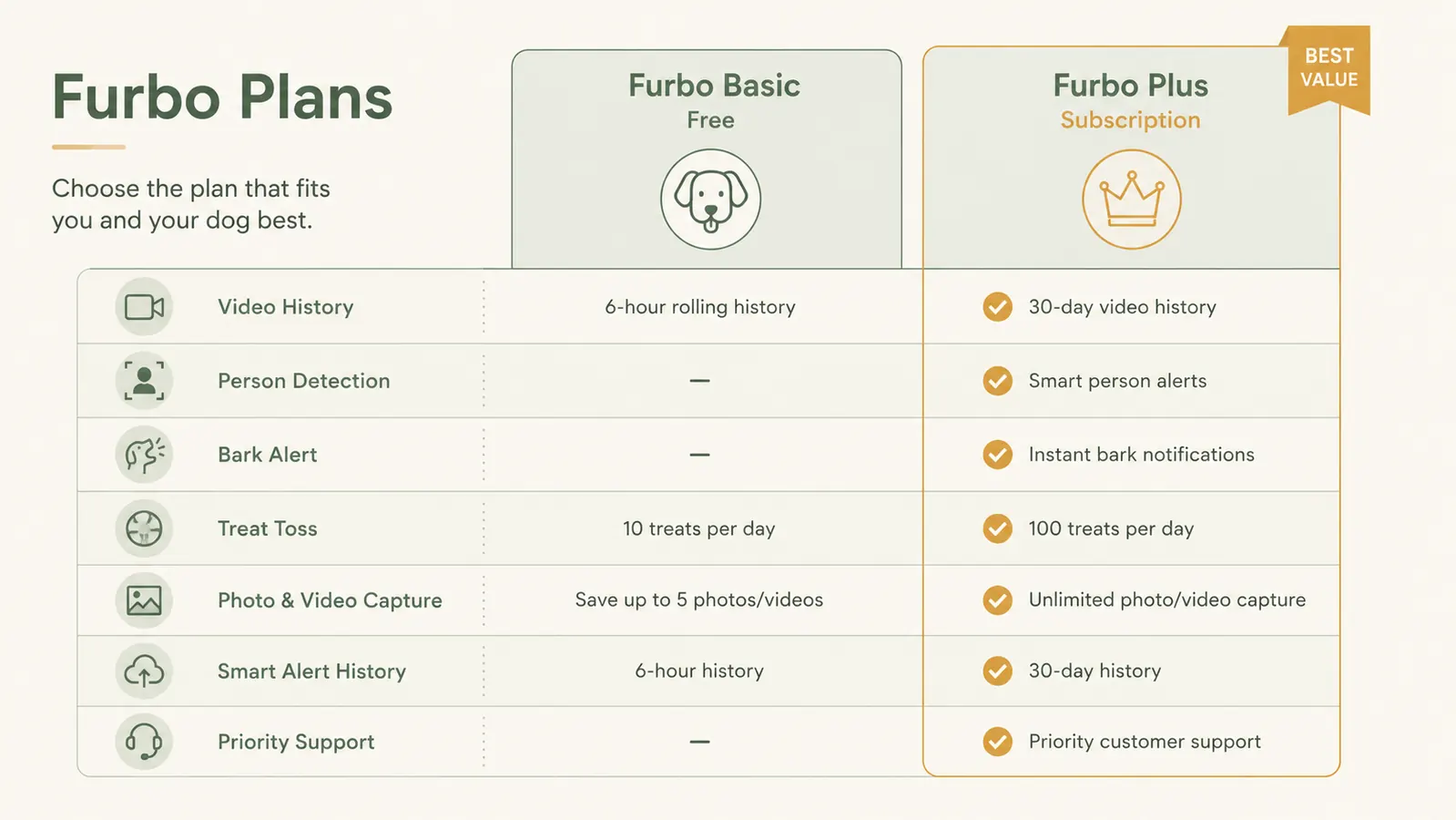
This is the part the product listing downplays, so I am going to lay it out plainly. Out of the box, with no subscription, you get live streaming, two-way audio, manual treat tossing, and basic motion detection. That is a usable camera. You can check in on your pet in real time and talk to them. For $99, that is a reasonable hardware value.
Where it gets complicated is Furbo Plus, the paid subscription tier. Behind it sits: video history (so you can scroll back to see what happened while you were away), person detection (which distinguishes a human from a pet so alerts are more specific), dog bark alerts sent to your phone, and the Furbo Dog Nanny feature that logs activity throughout the day. These are not minor additions. Video history alone matters a great deal if you are trying to understand a separation anxiety pattern rather than just catch a live moment.
I subscribed. For my situation, where I was actively trying to understand Clover's behavior timeline during the workday, video history was non-negotiable. But I want to be clear: if you are buying this as an occasional check-in camera and you are fine with live view only, the free tier genuinely works. The marketing language on the product page implies a richer free experience than you actually get.
Video and Audio Quality: Where the 2K Claim Holds Up
The 2K QHD resolution is the real deal in good light. During daytime hours, the image is sharp enough that I can read the collar tag on Clover from across the room. Color rendering is accurate and the wide-angle lens catches more of the room than I expected without the fish-eye distortion that plagued my previous budget camera. If you have a darker apartment or rely heavily on night vision, lower your expectations slightly: the night mode is infrared monochrome and the range is adequate but not exceptional.
Two-way audio is clear in both directions. Clover responds to my voice through the speaker, which is the primary emotional value for separation-anxiety dogs. Some cameras in this price range have a latency problem where the pet hears your voice a beat or two after you speak, which confuses them. I did not notice meaningful lag with the Furbo Mini 360 under a standard home WiFi connection.
The treat dispenser is genuinely useful, but only if you use it deliberately. A dog who learns to demand treats by staring at the camera is a problem you created.
The Treat Dispenser: Useful Tool, Requires Discipline
Here is what nobody in the marketing copy tells you about the treat toss: the mechanics work well, but the behavioral application requires intentionality. The dispenser fires small treats at an arc that lands approximately two to three feet in front of the unit. Accuracy depends on treat size. The product recommends treats under a half-inch, which eliminates most standard training treats and requires you to buy smaller pieces or cut down what you have. That is not a dealbreaker, but it is a practical detail that affects the first week of use.
Occasionally a treat lodges in the dispenser and the mechanism requires a gentle shake to clear. It happened to me about once every two weeks, and it was never a permanent jam, just a momentary interruption. If your dog is watching the camera at the moment it misfires and nothing comes out, they do tend to wander off disappointed, which is honestly a fairly minor frustration in the scheme of things.
Used correctly, where you toss a treat specifically when your dog settles onto their bed rather than when they are anxious or camera-focused, the dispenser is a meaningful behavioral tool. I have seen a measurable reduction in the amount of time Clover paces before settling after I leave, based on the activity log in the app. I cannot attribute that entirely to the treat dispenser, but it is part of the protocol.
Setup and App Experience: One Day-One Frustration Worth Knowing
Physical setup takes about ten minutes. The unit plugs in, the app guides you through WiFi pairing, and the camera is streaming within the first quarter hour. The app is clean and modern, navigation is intuitive, and the live view loads in roughly three to four seconds on a reliable WiFi connection.
The one frustration I want to flag: the Furbo Mini 360 requires a 2.4GHz or 5GHz WiFi network, but in my building's older infrastructure I had repeated dropout issues until I switched to 2.4GHz only. The camera recovered on its own after each dropout, but the app notification for "camera offline" was alarming until I understood what was causing it. If you have a dual-band router, parking the camera on a dedicated 2.4GHz network solved the problem entirely.
What I Would Change About the Hardware
The power cable exits from the bottom of the unit, which means surface placement requires routing the cord down and behind whatever furniture the camera sits on. This is a minor ergonomic gripe, but it affects how cleanly you can position it on a shelf versus mounting it on a wall bracket. A wall bracket is sold separately. For a $99 device, including the bracket would have been a nice touch.
The rotation motor, while quiet, is not silent. Clover notices it after the first few sessions. She does not react negatively, but she does orient toward the camera when it moves. Whether that matters depends on your behavioral goals. For passive monitoring, it is fine. If you are trying to observe what your dog does when they do not know they are being watched, you will want to position the camera to cover the most relevant area without needing to pan.
What I Liked
- Genuine 2K image quality that holds up in real daylight conditions
- 360-degree rotation covers the whole room without repositioning
- Treat dispenser with real behavioral utility when used intentionally
- Two-way audio with minimal latency, dogs recognize and respond to your voice
- Clean, well-organized app that does not require a tech background to use
- Free tier is genuinely functional for live-view-only use cases
Where It Falls Short
- Subscription required to unlock video history, bark alerts, and person detection
- Treat accuracy drops with treats larger than a half-inch
- Power cable exits from the bottom, complicating shelf placement
- Night vision is infrared monochrome with limited range
- WiFi dropout issues on some dual-band routers until manually parked on 2.4GHz
- Wall mount bracket sold separately

How It Compares to What I Used Before
Before the Furbo Mini 360, I used a budget camera I will not name and then a mid-range fixed camera from a competitor. The budget camera failed within three months. The mid-range camera had better build quality but no treat dispenser and a fixed field of view that left the majority of my living room off-screen. The Furbo Mini 360 is a genuine step up from both on the dimensions that matter for a separation-anxiety dog: full room coverage, two-way audio, and the behavioral intervention of the treat dispenser.
The comparison I know most readers are wondering about is the Petcube Bites 2, which is roughly in the same price range and also has a treat dispenser. I tested a Petcube briefly at a friend's house. The Petcube app felt slightly more polished on iOS in my experience, but the Furbo's rotating camera is a meaningful hardware advantage. If your dog is confined to a single area of a room, the Petcube's fixed angle is perfectly adequate. If you have a dog that moves around, the 360-degree coverage changes things materially.
Who This Is For
The Furbo Mini 360 is the right camera if you have a dog with any degree of separation anxiety and you want both visibility and an active intervention tool. The combination of full room monitoring, treat delivery, and two-way audio is a functional toolkit for reducing isolation distress. If you also plan to use the app daily and are willing to pay for the subscription to get video history, you will get genuine behavioral insight over time, not just occasional snapshots.
Who Should Skip It
If you want a camera for occasional peace-of-mind check-ins a few times a week and you have no serious behavioral concerns, there are simpler options at a lower price point that will serve you well without the subscription overhead. The Furbo Mini 360 is engineered for daily active use. If you buy it and open the app twice a week, you are paying for capability you are not using. A basic streaming camera with two-way audio at half the price would be a better match for light users.
Households with cats who ignore the camera entirely may also find the treat dispenser less useful. Cats are famously unmoved by being called to attention through a speaker. The device is sold as a pet camera, not a dog camera specifically, but the behavioral application is most effective for dogs.
Four months in, I would buy the Furbo Mini 360 again. But only because I use it every day.
If daily check-ins and active behavioral monitoring sound like your situation, it earns its price. Check today's price on Amazon and see the current subscription details in the listing.
Amazon Check Today's Price on Amazon →