

I set up the Furbo Mini 360 on a Thursday afternoon in November, mostly out of guilt. My Beagle mix, Pepper, was seven years old, mildly anxious, and had started barking in sustained runs after I left for work. My neighbor mentioned it. Twice. Six months later I have checked in on Pepper from a hospital break room, a parking garage, and a grocery store line. The camera has become part of our routine in ways I did not expect, and it has also frustrated me in ways the product page does not prepare you for.
This review covers the full arc of that experience: setup, early surprises, the subscription question, video quality in real-world conditions, how the treat dispenser actually performs, and where I have landed after six months of daily use.
The Quick Verdict
Genuinely good hardware let down by a subscription model that feels like a second purchase. The 360-degree rotation and 2K video are real differentiators. The free tier limits are real friction.
Amazon Check Today's Price →Your dog is home alone right now. You could check in before you finish reading this.
The Furbo Mini 360 delivers live 2K video, 360-degree pan, and remote treat tossing in a unit about the size of a tall coffee mug. It is currently one of the most-reviewed pet cameras in this category.
Amazon Check Today's Price on Amazon →How I Have Used It Over Six Months
My situation is probably typical: nine-to-five office job, single-dog household, no dog walker. Pepper is a five-year-old Beagle mix, 22 pounds, with a history of mild separation anxiety that shows up mostly as sustained barking in the first hour after I leave and occasional counter-surfing. I was not trying to solve a major behavioral crisis. I was trying to understand what was actually happening while I was gone, and to do something useful about it when I could.
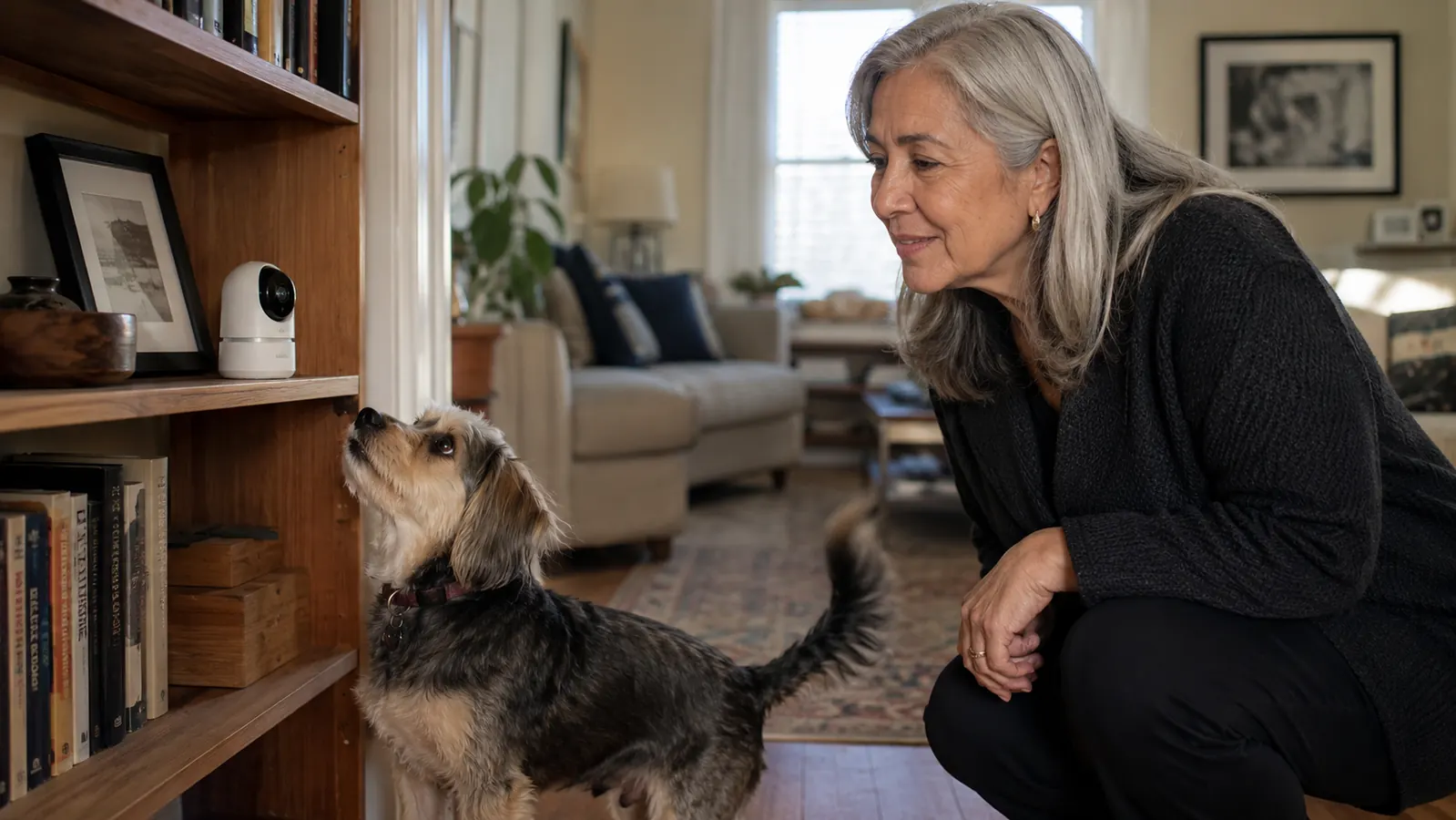
Setup took about twelve minutes. The app walked me through the steps clearly, the camera found my 2.4GHz network without complaint, and the physical placement took longer than the software part. I tried the kitchen counter first (too high for a useful downward angle), then a low bookshelf at about 24 inches off the floor that gave a good wide shot of the living room and the front door. That is where it has lived since. I check the camera an average of three to four times per workday, usually mid-morning, at lunch, and once in the late afternoon. The treat dispenser gets used two or three times a week, not daily.
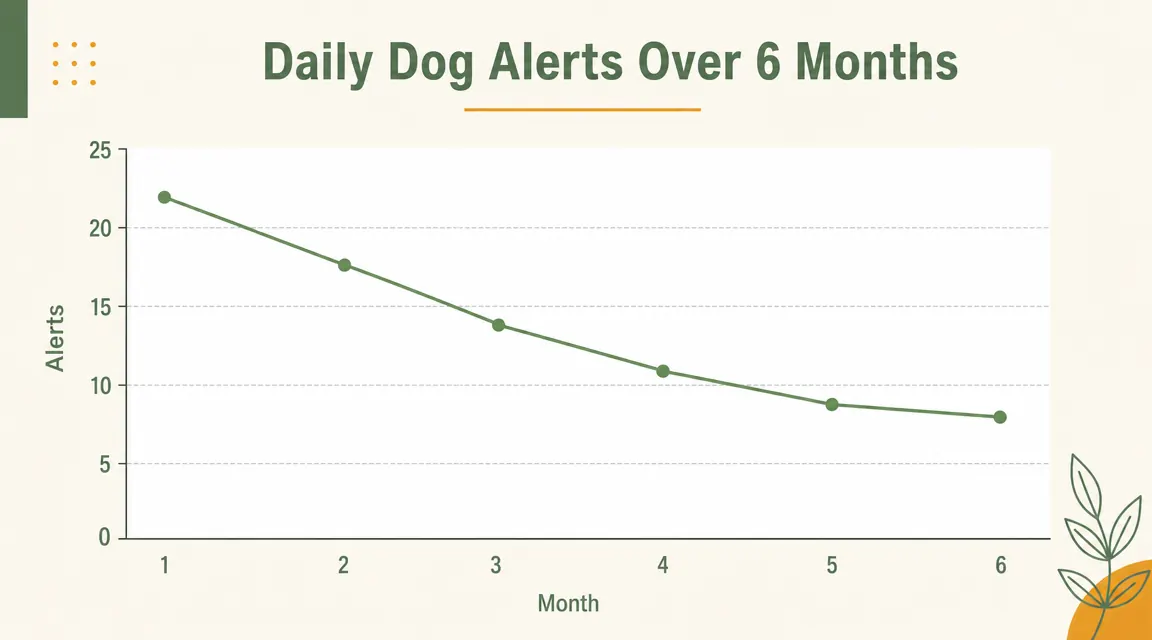
The biggest thing that changed in six months is not the hardware. It is that I stopped worrying about the first hour of the day. The Furbo sends a bark alert, I tap in, I see Pepper standing at the door, I talk to her through the speaker, sometimes I toss a treat, and she settles within two or three minutes most days. The neighbor has not mentioned the barking since February.

Video Quality and the 360-Degree Rotation
The 2K QHD resolution is the camera's strongest feature and it shows. The image is noticeably sharper than the 1080p cameras I compared during research, and it holds up in the varied lighting of a real living room across a full day. At 9 a.m. with morning sun coming through a west-facing window, the exposure adjusts smoothly. At 4 p.m. in dimmer conditions, the image stays usable without visible grain until the room gets genuinely dark. Night vision kicks in automatically and produces a clear enough image to see whether the dog is on the couch or on the floor, which is the level of detail I actually need after hours.
The 360-degree rotation is a genuine upgrade over fixed cameras. The motor is quiet enough that Pepper stopped reacting to it by week two. I can sweep the full room in about four seconds, which means I have never had the experience of checking in and simply not being able to find the dog. The field of view in any single fixed position is wide enough to cover the main living area without panning, so the rotation is more of a reassurance feature than a daily necessity. When Pepper is in the kitchen or a back corner, I use it. When she is in her usual spot, I do not need to.
The 2K image holds up in real living-room light conditions far better than I expected. After six months I have not once wished for a better picture.
The Treat Dispenser: What It Does and Does Not Do
The treat dispenser works, with some important size and placement conditions. The camera accepts treats up to about a third of an inch in size. I use the Zuke's Mini Naturals training treats and they feed reliably every time. I tried standard Milk-Bone biscuits once and immediately got a jam. After I cleared the chamber and switched back to the small treats, no further jams in six months. The launched treat lands anywhere from one to four feet in front of the camera depending on the specific toss, which is enough variability that Pepper has to hunt for it, which she seems to find engaging.
What the dispenser does not do is replace a walk, a training session, or a real interaction. I use it as a communication tool more than a reward tool. A tossed treat at 10 a.m. tells Pepper I have not forgotten about her, which seems to be the real function. Do not buy this camera expecting the treat tossing to fix separation anxiety on its own. Pair it with a behavioral protocol if anxiety is a real problem. The camera lets you monitor and respond; it does not do the training work for you.
The Subscription: Honest Math
This is the section most reviews skim past, and it is the one that most affects the real cost of ownership. The Furbo Mini 360 works without a subscription. You get live video, two-way audio, and manual treat tossing. That is a functional package on its own. What you lose without the subscription is bark alerts, dog activity tracking, smart alerts (the camera distinguishing between a dog, a person, and a package), and cloud video history. The plan runs roughly $7 to $9 per month depending on whether you pay monthly or annually.
For my use case, the bark alert was the feature I could not live without. The moment I realized Pepper was having a rough morning was never when I happened to open the app. It was when the phone buzzed with a bark notification. That prompt is what makes the camera a proactive tool rather than a passive one. So I pay for the subscription, and I have found it worth the monthly cost given that the alternative to using it was hiring a dog walker three days a week. Your math will differ based on how you actually use the check-in feature.
What I would prefer is a lower-cost tier that includes just bark alerts with no video history. The current free tier is limited enough that it feels more like a trial than a real option, and the paid tier is functional enough that it feels like the product's actual intended mode. That is a legitimate business model complaint. It is not a product failure.
Audio Quality and Two-Way Communication
The speaker is loud enough to be heard across a standard room. Pepper responds to my voice through the Furbo the same way she responds when I am physically in the room, which still feels slightly strange. The microphone on my end picks up environmental noise from the camera's room, so I can hear her panting, walking, and barking clearly. I cannot hear ambient noise from my end clearly on the dog's side, which means she mostly just hears my voice without background cafe noise when I call from outside. That turned out to be a feature, not a limitation.
Durability and Long-Term Reliability
The unit itself has held up without issues over six months. No connectivity drops that were not traceable to my home wifi rebooting. No mechanical problems with the rotation motor. The treat chamber does need wiping down every two or three weeks because treat dust accumulates at the bottom and can affect the dispensing mechanism if ignored. The exterior casing has not yellowed or shown wear under normal indoor conditions. The base is weighted enough that Pepper has bumped into the bookshelf twice without knocking the camera over.
App stability has been mostly good with one notable exception: a firmware update in February pushed a change that broke background notifications for about four days until a follow-up patch came through. The Furbo support team acknowledged the issue and communicated via email, and the fix arrived faster than I expected. It was annoying, but not a confidence-breaking event. Software updates in connected devices occasionally go sideways, and the way a company handles the recovery matters more than the fact that it happened.
What I Liked
- 2K QHD video is genuinely better than most competitors at this price point
- 360-degree rotation means you can always find where the dog actually is
- Bark alert notification is fast, usually under 10 seconds from event to phone buzz
- Compact footprint fits on a shelf without dominating the room
- Setup is simple, under 15 minutes including account creation
- Night vision is usable for confirming dog position in low light
Where It Falls Short
- Free tier is functional but limited; bark alerts require the paid subscription
- Treat dispenser is size-sensitive, small training treats only, standard biscuits jam
- Subscription feels like a second purchase decision after buying the hardware
- Firmware updates have occasionally affected notification reliability temporarily
- App can be slow to load live feed on a weak cellular connection

Who This Is For
The Furbo Mini 360 is best suited for working pet owners who need a reliable way to check in on a single dog or cat during the workday, respond to distress signals in real time, and provide a small treat-based interaction to interrupt anxious patterns. It is particularly useful if your dog is past the acute destruction phase of separation anxiety but still shows signs of distress in the first hour of the day. The 360 rotation is valuable in medium to large rooms where a fixed camera would require you to guess whether your pet is in frame.
It is also a solid choice for anyone who has ever come home to a counter-surfing surprise and wanted to understand when and why it happens. The activity log and bark alert history, available on the paid plan, let you see patterns across weeks rather than just individual events. That data is genuinely useful for behavioral work with a trainer or vet.
Who Should Skip It
If you have a multi-pet household with animals on different floors or in separate rooms, a single Furbo will leave gaps. You would need multiple units, which multiplies both the hardware cost and the subscription cost. If treat tossing is the primary feature you want and live video is secondary, a simpler, cheaper dispenser-only device might serve you better at lower ongoing cost. And if you are philosophically opposed to subscription-gated features on hardware you have already purchased, be honest with yourself before buying: the free tier is not the product Furbo designed this camera to be used with.
For families with very severe separation anxiety cases, no remote camera replaces a structured behavioral intervention program. The Furbo can be a useful tool within that program, but I would not position it as a stand-alone solution for dogs with clinical anxiety. Talk to your vet before relying on any tech solution for that level of distress.
Six months in, I would still buy this camera again. Mainly because of the bark alert and the rotation.
The Furbo Mini 360 combines 2K live video, 360-degree pan, two-way audio, and a treat dispenser in one compact unit. It is currently rated 4.4 stars across more than 6,000 reviews. Check the current price before deciding whether the subscription math works for your situation.
Amazon Check Today's Price on Amazon →If you are comparing options before committing, see our head-to-head breakdown in Furbo Mini 360 vs Petcube Bites 2, which covers video resolution, app experience, treat accuracy, and subscription pricing side by side. And if you are dealing with a dog who actively struggles when left alone, the step-by-step placement and protocol guide in How to Set Up a Pet Camera Treat Dispenser for Home-Alone Dogs covers the behavioral layer that the hardware alone cannot handle.