

If your dog is home alone right now, you have probably already Googled "best pet camera with treat dispenser" at least once this week. Two names keep coming up: the Furbo Mini 360 and the Petcube Bites 2 Lite. Both rotate to follow your pet, both launch treats from your phone, and both land at roughly the same price point. So why does the choice feel harder the more you research it? Because the differences that actually matter, subscription structure, video clarity, treat accuracy, and long-term app reliability, are buried under marketing copy.
This comparison is the one I wish I had found before buying. I will walk through every meaningful difference, tell you who each camera is best suited for, and give you a clear recommendation. The short answer: the Furbo Mini 360 is the stronger buy for most households. But there is a specific type of dog owner for whom the Petcube makes more sense, and I will tell you exactly who that is.
| feature | left | right |
| feature | left | right |
| feature | left | right |
| feature | left | right |
| feature | left | right |
| feature | left | right |
| feature | left | right |
| feature | left | right |
| feature | left | right |
| feature | left | right |
Where the Furbo Mini 360 Wins
The most noticeable advantage is the camera itself. At 2K QHD, the Furbo Mini 360 streams noticeably sharper footage than the Petcube Bites 2 Lite, which tops out at 1080p. The difference becomes clearest in low-light conditions. Furbo uses color night vision, meaning you see your dog in soft amber tones rather than the flat, gray-green cast of infrared. If your dog sleeps in a dim room and you check in after dark, the Furbo image simply looks better.
The 360-degree motorized rotation is the other major differentiator. The Petcube Bites 2 Lite has a fixed lens with a 160-degree wide-angle field of view. That covers a decent chunk of a room, but if your dog moves to a corner behind the camera's range, you lose them. The Furbo rotates on command from the app, so you can pan around to find your dog wherever they have wandered. For open-plan homes or dogs that move room to room, this is a genuine functional advantage. The Petcube cannot match it.
Subscription cost also tips toward Furbo. Furbo Care runs $6.99 per month for a single camera. Petcube Care is $9.99 per month for equivalent features. Over a year, that is a $36 difference, which is real money for a feature set that is roughly comparable between the two platforms. Furbo's subscription unlocks smart alerts, 24-hour cloud recording, and their dog-activity timeline. Petcube's subscription unlocks similar cloud storage and alert filtering. Neither subscription is mandatory, but both cameras lose meaningful functionality without one.
Where the Petcube Bites 2 Lite Wins
The Petcube has one genuine advantage worth naming: treat dispenser range. The Petcube Bites 2 Lite launches treats up to six feet. Furbo's toss range is shorter and less consistent, particularly with smaller treats. If your dog does not naturally sit near the camera, the Furbo toss can fall short, frustrating the dog and you. The Petcube's stronger launcher makes it more forgiving about camera placement.
The Petcube app has also historically received higher marks for stability from long-term users. Furbo's app went through a rough patch in 2023 after a major subscription restructuring, when many users reported dropped connections and push-notification failures. Furbo appears to have addressed most of these issues with subsequent updates, and recent reviews are considerably more positive. But if rock-solid app reliability is your top priority and you have a friend with a Petcube who has never complained about it, that track record counts for something.
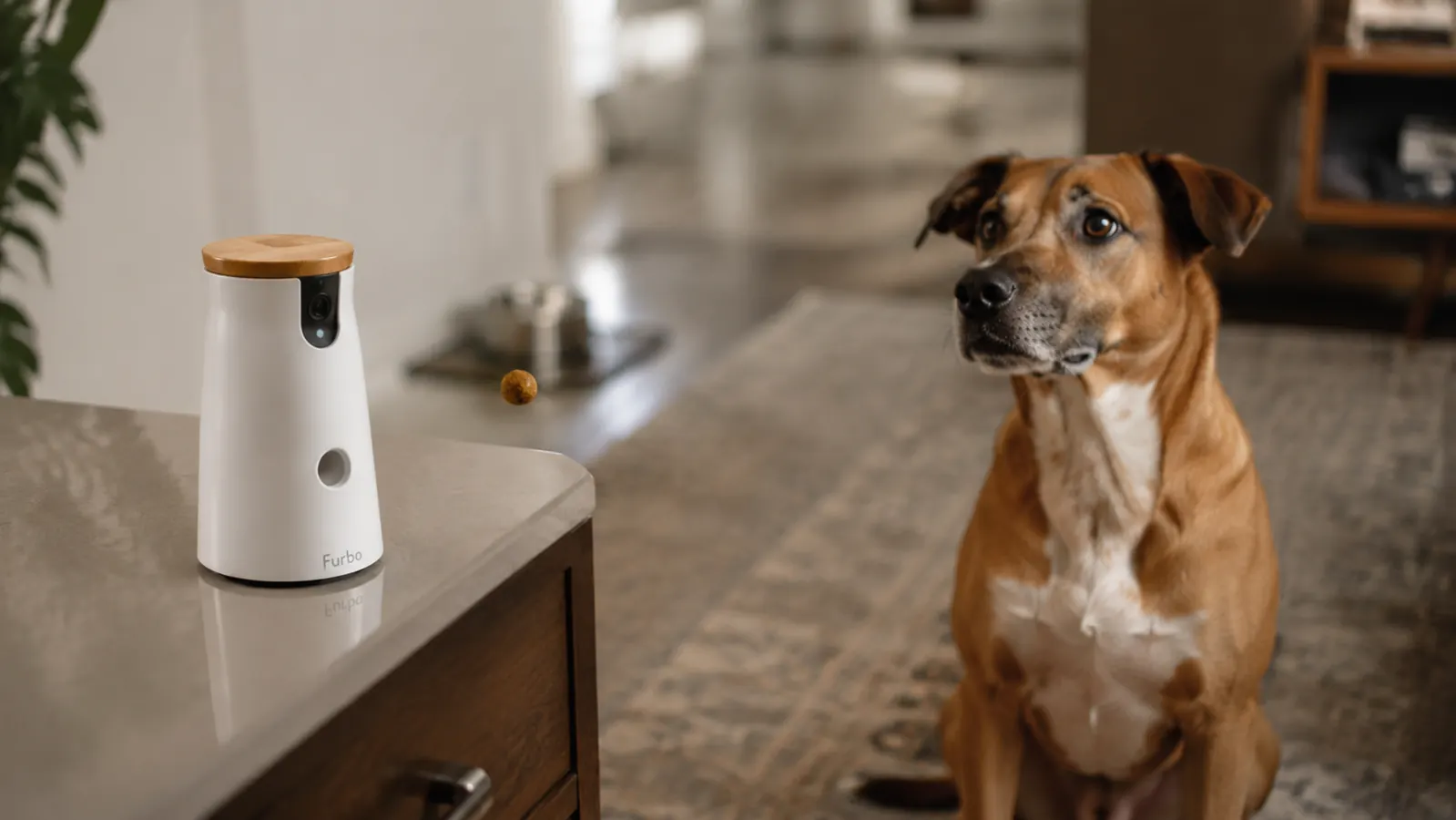
Your dog is home right now. The Furbo Mini 360 shows you exactly what they are doing.
2K video, 360-degree rotation, and remote treat tossing from your phone. Over 6,000 verified reviews with a 4.4 rating. Ships from Amazon with standard return protection.
Amazon Check Today's Price on Amazon →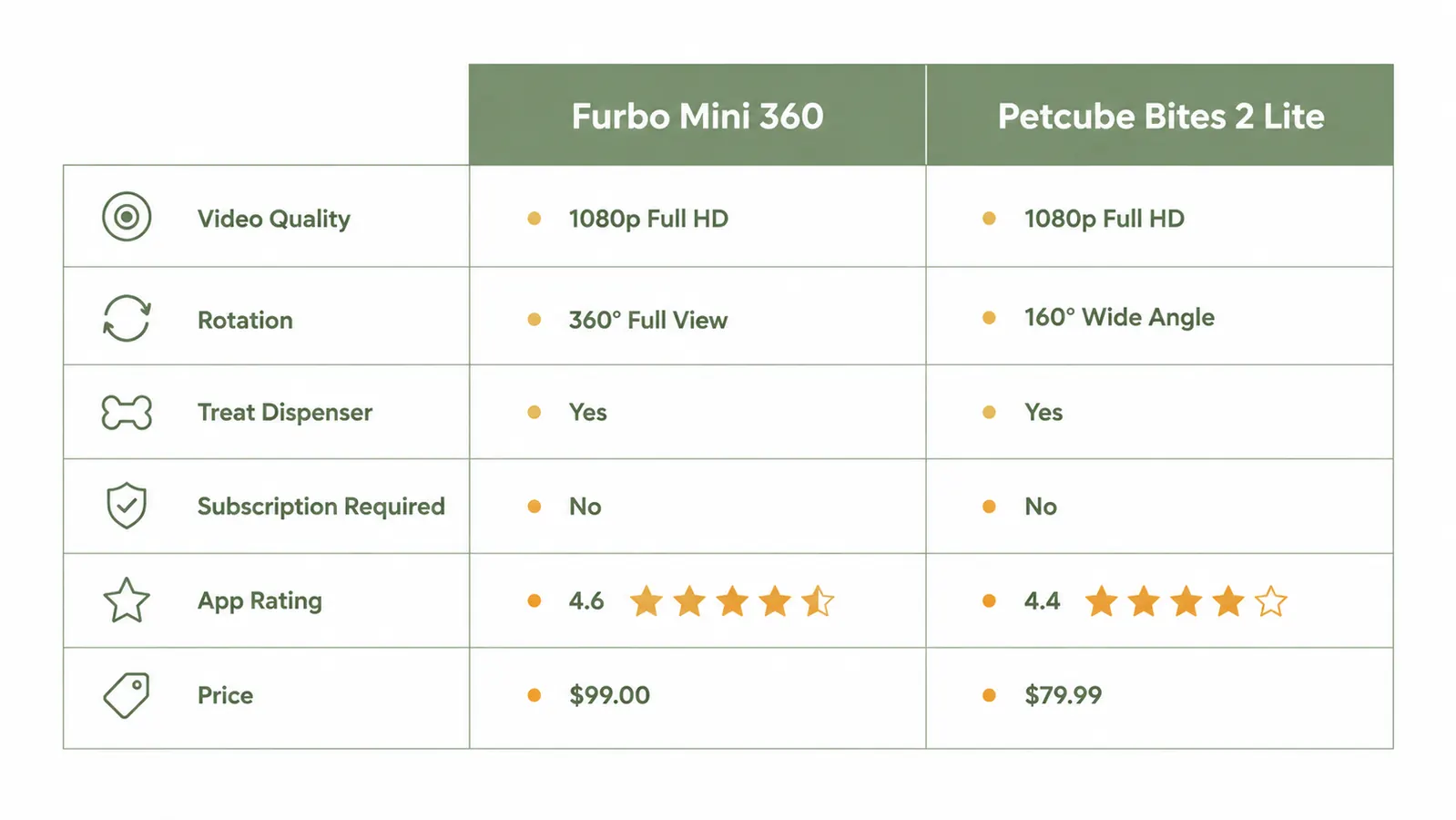
Video Quality: A Closer Look
This is where the Furbo pulls away from the competition in a way that matters day to day. At 2K, you can read the expression on your dog's face. You can see if they are panting, if their ears are pinned back with anxiety, or if they are simply napping. With 1080p footage on the Petcube, you can tell what your dog is doing, but fine behavioral detail gets soft at zoom. If you are using the camera to monitor a dog with separation anxiety or post-surgery recovery, the additional resolution genuinely changes what you can observe.
Night vision approach also matters more than spec sheets suggest. The Furbo's color night vision renders the environment in warm, readable tones without any IR glow that might startle a light-sensitive dog. Petcube's infrared night vision produces clear images but in the classic gray-green tones of traditional IR, and it emits a faint red light that some dogs notice. Neither is disqualifying, but if your dog is already anxious, the Furbo's more neutral light output is a quieter option.
The 360-degree rotation is not a gimmick. When you cannot find your dog on the live feed, being able to pan the camera from your phone is the difference between knowing they are fine and texting your neighbor to check.
Subscription Costs: What You Are Actually Paying Over Time
Both cameras work without a subscription. You get live streaming and two-way audio on either platform at no monthly cost. Where subscriptions diverge is in smart features: motion-triggered clip saving, intelligent dog-bark alerts versus generic motion alerts, cloud storage history, and activity summaries. Without a subscription on either camera, you can watch your dog live, but you cannot review a saved clip from 11am if something was wrong when you got home at 6pm.
At $6.99 per month, Furbo Care costs about $84 per year. Petcube Care at $9.99 per month is $120 per year. Over three years of ownership, that is a $108 difference, enough to cover roughly a year and a half of Furbo's subscription for free. If you plan to use the subscription features long-term, that gap is worth factoring into the purchase decision from the start. Budget the total cost of ownership, not just the hardware price.

Treat Dispenser Accuracy: Does It Actually Work?
Both cameras use a mechanical launch mechanism that flings a treat out of the front of the unit when you press a button in the app. Both work best with small, lightweight, dry treats, think training-size soft treats or small kibble pieces. Neither handles large biscuits or sticky treats reliably.
The Furbo toss is generally accurate but can vary based on treat weight and shape. Smaller, lighter treats sometimes land closer to the base of the camera rather than reaching the dog if they are sitting more than four feet away. The Petcube's stronger spring mechanism covers more distance. If your camera placement puts your dog at a consistent distance of five to six feet, the Petcube has the more reliable throw. If your dog tends to sit right below the camera, the Furbo works perfectly. Consider where you would realistically mount each camera in your home before treating this as a dealbreaker.
Who Should Buy Which
Choose the Furbo Mini 360 if you want the best video quality in the category, plan to use the camera in a room where your dog moves around, and want to spend less on the monthly subscription over time. The 2K resolution and 360-degree rotation cover most of what makes a pet camera genuinely useful rather than just a novelty. It is the better camera for most households, and at 6,000-plus reviews with a 4.4 rating, it has a strong enough sample size to trust.
Choose the Petcube Bites 2 Lite if you have a specific placement in mind where the camera sits at a fixed angle looking down a hallway or at a crate, you prioritize treat-toss range over rotation, or you already have a Petcube ecosystem and want a consistent app experience. The Petcube is also a reasonable choice if app stability history matters to you and you have had friends or family recommend it from personal experience. It is a solid camera. It just does not outperform the Furbo on the specs that matter most to the widest range of users.
There is one scenario where neither camera is the right call: if you have a cat who is indifferent to treat-dispensing, or a dog with severe separation anxiety that a camera alone cannot address, the hardware will not solve the underlying problem. A camera is a monitoring and enrichment tool, not a behavioral intervention. For dogs with true separation distress, a camera paired with a trainer and a desensitization protocol will do far more than a camera alone.
The Furbo Mini 360 is the pick for most homes. Here is where to get current pricing.
2K QHD video, 360-degree motorized rotation, color night vision, and a treat dispenser you can trigger from your lunch break. The subscription costs less than the Petcube alternative, and the hardware is a clear step up on resolution.
Amazon Check Today's Price on Amazon →