
If your dog has been diagnosed with early joint disease, or you are watching a senior dog slow down on stairs, you have almost certainly landed on Nutramax products. Cosequin and Dasuquin are the two most-recommended joint supplements in veterinary offices in the United States, and they come from the same company. So the question that trips up every dog owner is a reasonable one: why does Dasuquin cost nearly double what Cosequin costs, and is the difference worth paying for your specific dog?
The short answer is that both supplements work, but they work through slightly different mechanisms, and one of them carries an additional active ingredient that has meaningful research behind it for moderate to severe joint disease. Which formula belongs in your cabinet depends less on price tolerance and more on where your dog currently sits on the joint health spectrum. Here is the full breakdown.
| attribute | left | right |
| attribute | left | right |
| attribute | left | right |
| attribute | left | right |
| attribute | left | right |
| attribute | left | right |
| attribute | left | right |
| attribute | left | right |
| attribute | left | right |
| attribute | left | right |
| attribute | left | right |
Where Cosequin Wins
Cosequin DS has been the most studied over-the-counter glucosamine-chondroitin supplement in veterinary medicine for more than two decades. It carries the NASC (National Animal Supplement Council) quality seal, and Nutramax publishes its internal testing data on potency and purity. For dogs in the early stages of joint wear, or dogs under seven years that you are supplementing preventively, Cosequin DS delivers a clinically relevant dose of glucosamine and chondroitin at a daily cost that is easy to maintain long term. The 500 mg glucosamine and 400 mg chondroitin per chew falls within the range used in positive canine trials.
There is also a practical argument for Cosequin that does not show up in the ingredient list: palatability across a wide range of dogs and ease of use. The chewable tablet form is accepted by most dogs as a treat, which matters more than it sounds when you are committing to a supplement for the rest of a dog's life. Cosequin also comes in a sprinkle capsule for picky eaters and a higher-count supply size that lowers the per-dose cost significantly for large and giant breeds on long-term maintenance.
Where Dasuquin Wins
The defining difference between Dasuquin and Cosequin is the addition of ASU, or avocado-soybean unsaponifiables. ASU is a plant-derived extract that has been studied specifically as a cartilage-protective agent in canine osteoarthritis research, including work published in the Journal of Veterinary Internal Medicine. The proposed mechanism is that ASU inhibits certain pro-inflammatory compounds and may support the structural integrity of cartilage over time. This is not a miracle additive, but for dogs with a confirmed diagnosis of moderate to severe osteoarthritis, the addition of ASU gives Dasuquin a more complete therapeutic profile than glucosamine and chondroitin alone.
Dasuquin Advanced also includes slightly higher doses of both glucosamine and chondroitin compared to the standard Cosequin DS formula, which may matter for large and giant breeds. If your vet has already tried Cosequin with your dog and you are not seeing the mobility improvement you expected after 90 days, Dasuquin is the logical upgrade to try before moving to a prescription NSAID. It gives the joint support stack one additional mechanism to work with, and many owners report a noticeable difference when switching mid-cycle.
Your dog's joints are not getting younger. Cosequin DS is where most vets start.
With 78,000-plus reviews and NASC certification, Cosequin DS is the most trusted entry point for dog joint support. If your dog is in the early to moderate range, this is the supplement we would reach for first.
Amazon Check Today's Price on Amazon →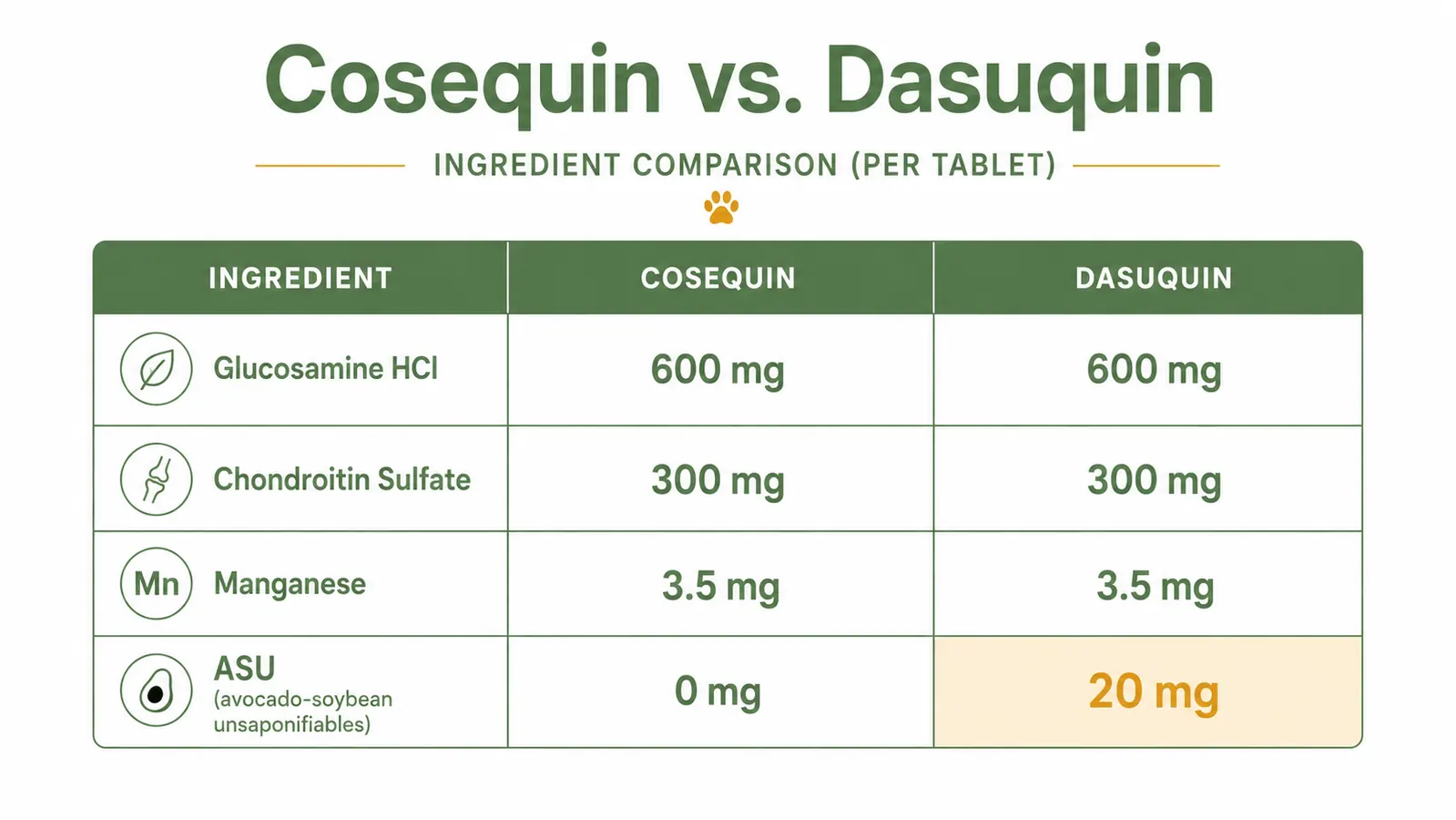
The Ingredient Science: What ASU Actually Does
Glucosamine and chondroitin work primarily as building-block substrates. Glucosamine HCl is a precursor to glycosaminoglycans, the compounds that form the structural matrix of cartilage. Chondroitin sulfate helps cartilage retain water and resist compression. The combination is well-supported in dogs, though the degree of benefit varies by individual, stage of disease, and how consistently the supplement is given.
ASU adds a different layer. Rather than feeding the cartilage building process, ASU works at the inflammatory signaling level, targeting specific cytokines (particularly IL-1 beta) that drive cartilage breakdown in osteoarthritis. Think of glucosamine as rebuilding what is damaged, and ASU as slowing the rate of ongoing damage. In practice, a dog with early stiffness may see sufficient relief from glucosamine and chondroitin alone. A dog whose cartilage has already deteriorated significantly is more likely to benefit from the combined approach.
Switching from Cosequin to Dasuquin after month three was the right call for my ten-year-old Lab. It took about six weeks, but she started using the stairs without hesitation again. The ASU was the only variable I changed.

The Real-World Cost Difference
For a large dog, Cosequin DS typically costs roughly half what Dasuquin Advanced costs per day when bought in the large supply sizes available on Amazon. Over twelve months, that gap adds up to a meaningful number, which is why the starting point matters. There is no reason to pay for Dasuquin's ASU content if your dog is four years old with no joint symptoms and you are supplementing purely preventively. But if your dog is already limping on cold mornings or has a diagnosis of hip dysplasia, the daily cost difference is smaller than the cost of a single vet NSAID prescription, and the ASU-enhanced formula is worth the investment.
It is also worth noting that the per-dose cost gap narrows when you buy both products in their largest supply sizes. Nutramax sells large-count versions of both products on Amazon that significantly reduce the per-chew price, and if you are on a long-term supplement plan for a senior dog, buying in bulk is where you recover most of the price difference.
Who Should Buy Which
Start with Cosequin DS if your dog is under eight years old, has no confirmed joint diagnosis, or if your vet recommends starting with a standard glucosamine-chondroitin formula. It has the longest clinical record in dogs, the widest availability, and the lowest barrier to long-term consistency. The majority of dog owners who ask this question are appropriate Cosequin candidates, not Dasuquin candidates, because most dogs benefit from prevention-tier supplementation rather than disease-management-tier supplementation.
Move to Dasuquin Advanced if your dog has moderate to severe osteoarthritis, if 90 days of Cosequin produced limited improvement, if your vet specifically mentioned ASU as a consideration, or if your dog is a large or giant breed with a genetic predisposition toward joint disease (Labradors, German Shepherds, Rottweilers, Great Danes). In those cases, the research case for ASU is strong enough to justify the extra daily cost without hesitation.
One practical note on the comparison: if cost is a significant constraint and your vet recommends the full ASU stack, there are generic ASU supplements available that can be given alongside Cosequin rather than replacing it. That approach gives you the same three active ingredients at a lower combined cost than purchasing Dasuquin. The formulation logistics are slightly more complex, but the outcome is pharmacologically equivalent. Ask your vet before adding any separate supplement to an existing regimen.
Cosequin DS has 78,000-plus reviews and a multi-decade veterinary track record. It is the right first move for most dogs.
Whether you are starting joint support for a middle-aged dog or maintaining a senior who has already responded well to glucosamine, Cosequin DS is the most dependable starting point in this category.
Amazon Check Today's Price on Amazon →