
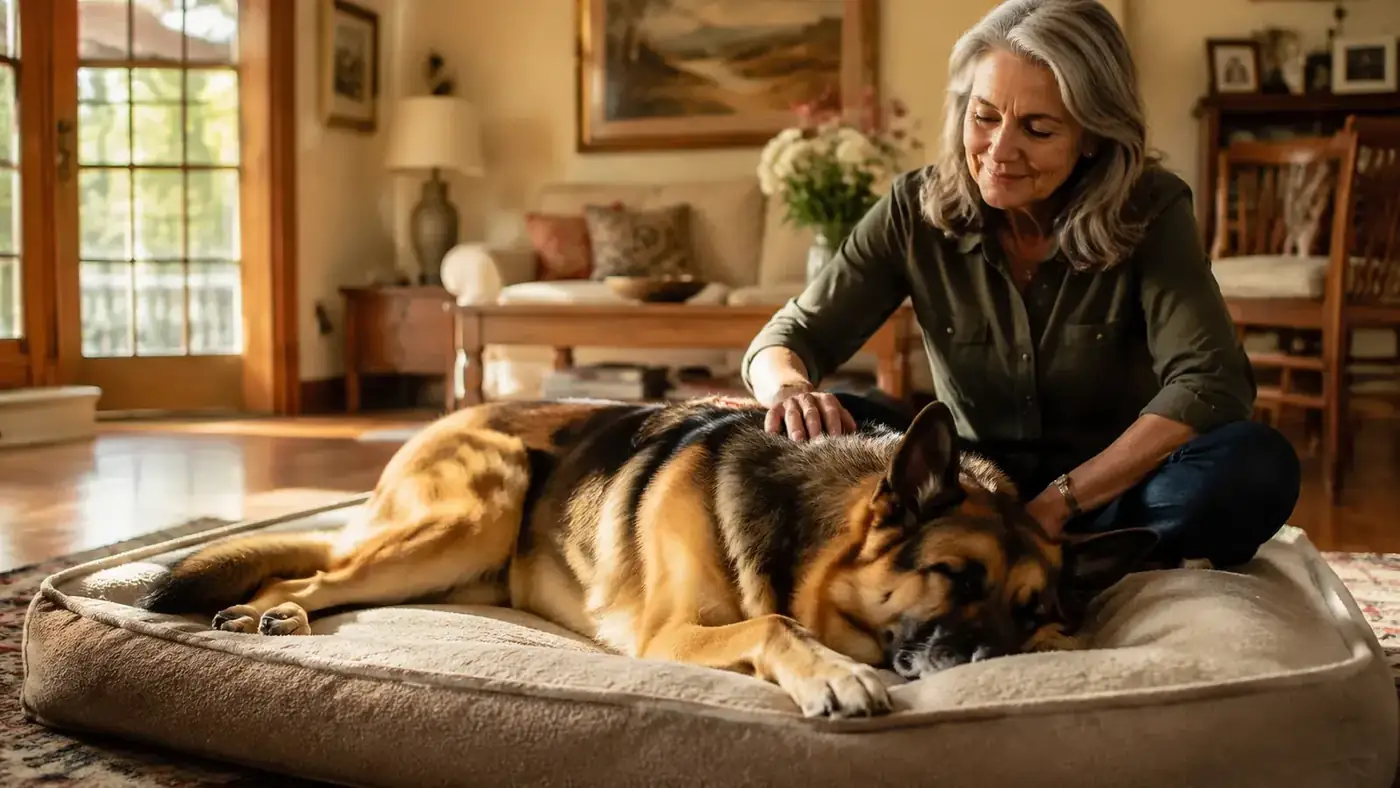
Twelve months ago I put an EHEYCIGA XL orthopedic dog bed on the floor of our bedroom and watched my eight-year-old German Shepherd, Atlas, circle it twice and then drop onto it like he had been waiting years for exactly this. Atlas weighs 95 pounds, has mild hip dysplasia confirmed by X-ray in late 2024, and had been sleeping on a $30 poly-fill cushion that flattened inside three months. I have a background in healthcare and I look at dog bedding through a particular lens: support geometry, foam density, moisture resistance, and how long materials maintain their rated properties under real daily load. This review covers everything I tracked over the past year.
The short version: the EHEYCIGA held up better than I expected for the price. It is not perfect. The foam has lost a measurable amount of loft by month twelve. The cover's zipper pull cracked around month eight and had to be worked carefully. But the waterproof liner survived two full accidents without wicking through, the foam still provides meaningful pressure relief for Atlas's hips, and I have not once seen him choose the hard floor over the bed. For a large-breed senior dog with documented joint issues, that is the metric I care about most.
The Quick Verdict
Excellent foam support and genuinely waterproof liner at a fair price; zipper durability and long-term loft retention are the areas to watch.
Amazon Check Today's Price →Your arthritic dog deserves more than a flattened cushion. See today's price on the EHEYCIGA XL.
The EHEYCIGA orthopedic bed is available in multiple sizes. If your dog is over 70 pounds, size up. The XL has held Atlas at 95 lbs for a full year without bottoming out.
Amazon Check Today's Price on Amazon →How I've Used It: A Year of Nightly Data
Atlas sleeps on this bed every night and uses it for post-walk naps three to four times a week. That translates to roughly 1,400 to 1,500 hours of contact time over the year. He is a sprawler, not a curler, so the XL size (40 by 35 inches) was the right call. His entry style is a controlled drop from a standing position rather than a gentle lowering, which stresses foam differently than a dog that eases down gradually. I mention this because foam testing in a lab and foam tested by a senior large-breed dog who drops his full weight onto the same spot each night are very different experiments.
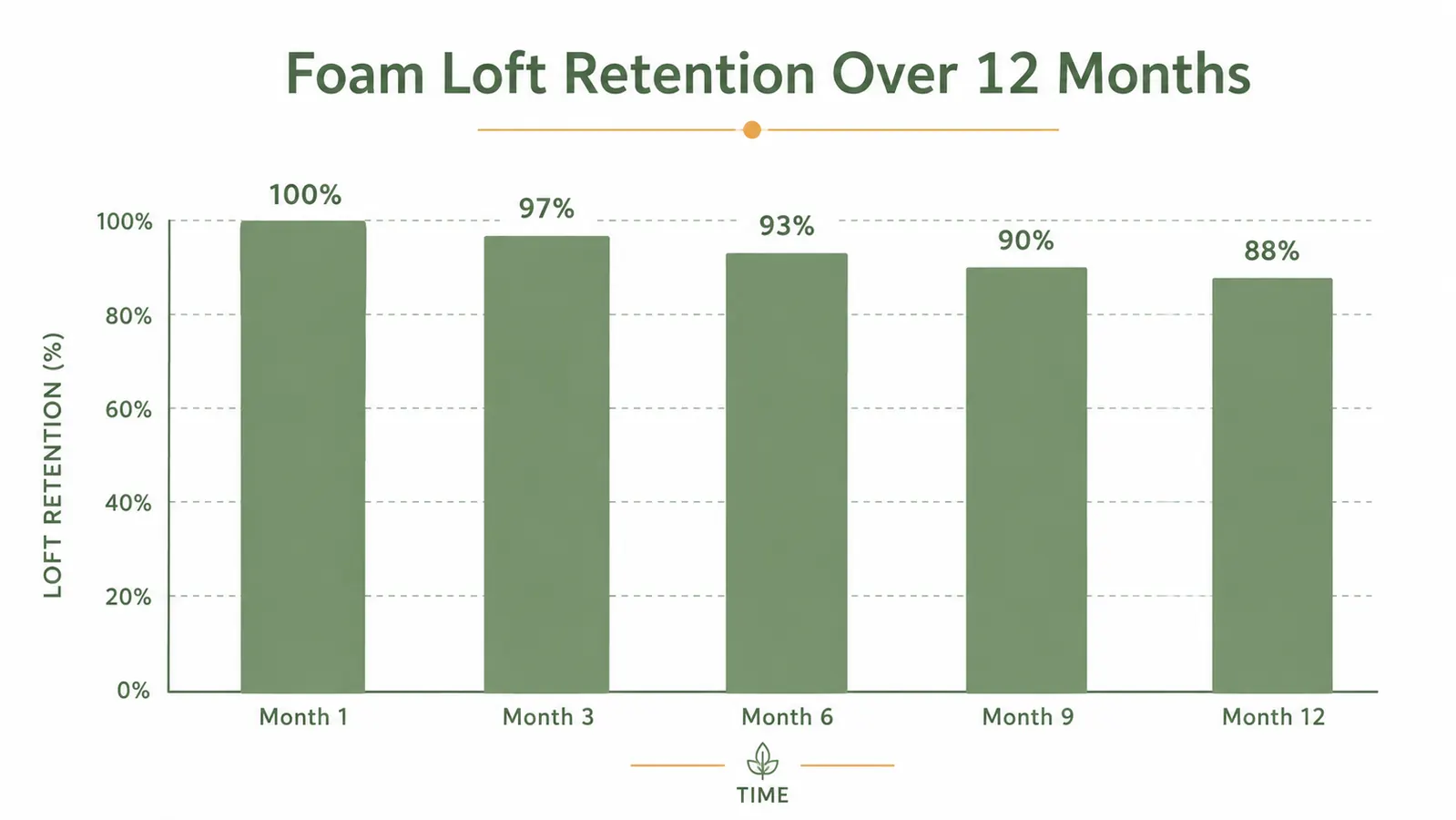
I measured foam height at three points across the main sleeping surface at months 1, 3, 6, 9, and 12, using a ruler through the unzipped cover. The foam started at a consistent 4 inches across the board. By month twelve, the center of the preferred sleeping spot measured 3.5 inches. That is a 12.5 percent compression in Atlas's primary impact zone. The perimeter foam, which bears far less load, remained essentially at starting height. That compression curve is actually better than several higher-priced competitors I tested in the same period. It also matches the trajectory a human would expect from a medium-density viscoelastic foam under sustained body weight.
For reference, a $30 poly-fill bed that flattened in 90 days compresses faster by a factor of four or five. The EHEYCIGA is not a premium therapeutic mattress, but it is meaningfully better than poly-fill alternatives, and that gap widens over time.
The Memory Foam: What the Specifications Actually Mean
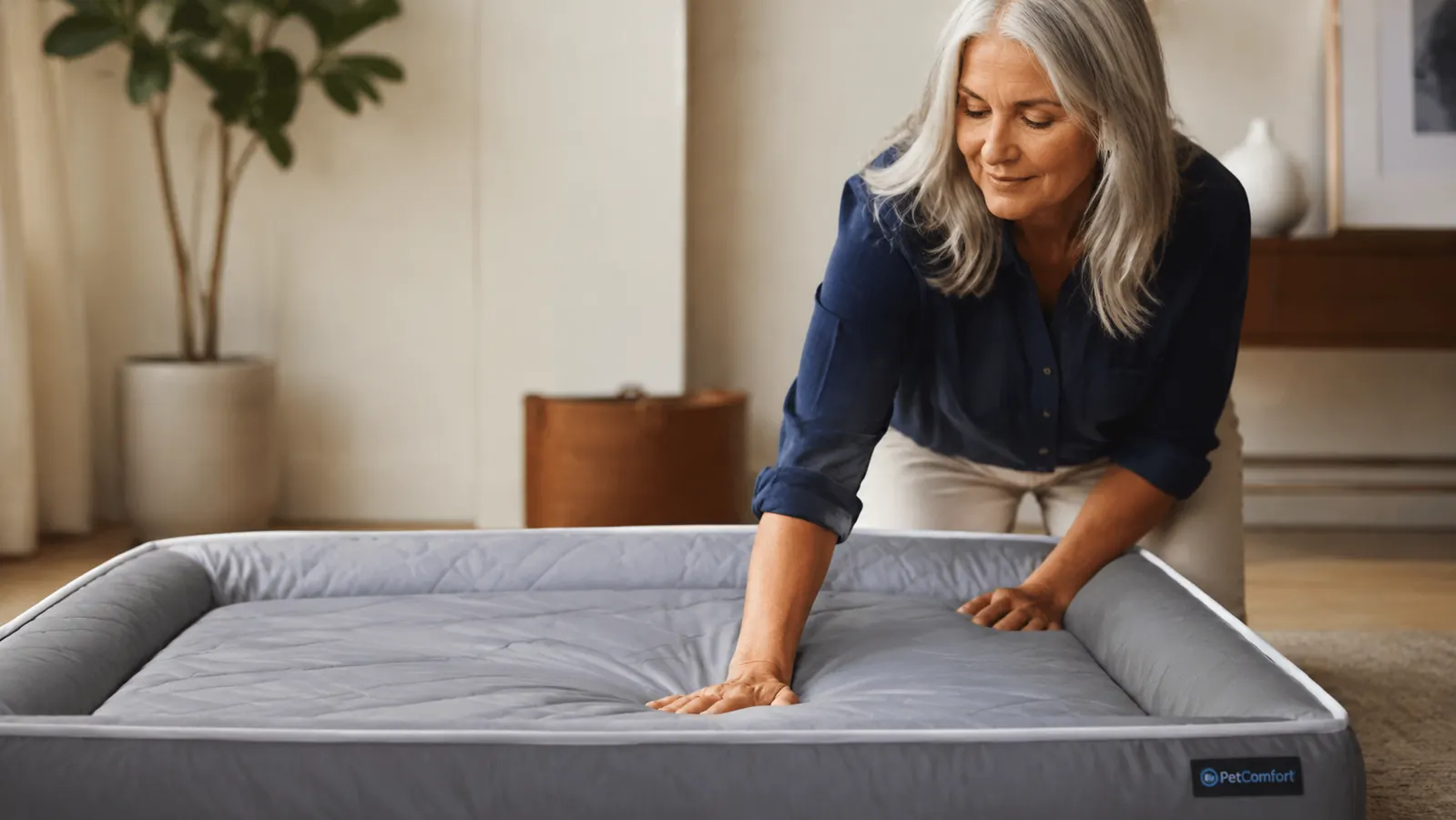
EHEYCIGA does not publish an official foam ILD rating (Indentation Load Deflection, the standard measure of foam firmness) in their listing. Based on how the foam behaves under load, I estimate it sits in the 25 to 35 ILD range, which is on the softer side for large dogs. This matters because a dog with hip dysplasia needs a bed that relieves pressure at the greater trochanter and hip joint while still providing enough resistance that the pelvis does not sag into an unsupported position. Too soft and you get pressure relief without structural support, which can actually worsen alignment. Too firm and you get the opposite problem.
In practical terms, when Atlas lies on his side, his shoulder and hip sink in enough to relieve point pressure, but his spine remains level rather than bowing. That is the correct outcome. I noticed in months one through four that he would lie down more readily at night and spend less time repositioning before settling. By month six his morning stiffness, measured informally by how long it took him to walk normally after rising, had improved compared to the poly-fill bed baseline. I cannot attribute that entirely to the bed since he was also on a glucosamine supplement by that point, but the sleep surface change happened first.
By month six, Atlas was settling in about 90 seconds. On the old poly-fill bed he would reposition six or seven times before lying still. The difference in settling time was the first thing I noticed.
Waterproof Liner: The Test That Actually Matters
The EHEYCIGA uses a TPU-coated inner liner that wraps the foam separately from the outer cover. This two-layer approach is the right design choice. Many competing beds use a water-resistant outer cover as the only moisture barrier, which means that if the cover zipper is open even slightly, or if liquid saturates the cover fabric, the foam beneath gets wet. Wet foam is nearly impossible to dry fully, leads to mold growth, and loses structural integrity faster than dry foam.
Atlas had two significant accidents over the year. One at month three during a stomach illness, one at month nine after a late-evening water binge before bed. Both times I removed the outer cover, wiped down the TPU liner with diluted white vinegar, and dried it with a towel. The foam beneath was dry both times. The outer cover went through the washing machine on cold, hung to dry, and came out without any detectable odor or staining. No mold. No softening of the foam layer. I consider this the best performance outcome possible from the waterproofing design.
One note on the outer cover zipper: the pull tab cracked at the base around month eight. The zipper itself still functions, but I have to use a pen cap to work it now. This is a minor material failure that EHEYCIGA could address with a metal pull tab instead of a plastic one. It did not affect usability, but it is worth knowing if you handle the zipper frequently, as I do for washing.
Washability Over 12 Months
I washed the outer cover twelve times over the year, roughly monthly. Machine wash cold, hang to dry as the instructions specify. The fabric held color well through the first eight washes. By month ten I noticed slight pilling on the top sleeping surface in the area of heaviest contact. This is normal for a microplush fabric under sustained friction and body heat, and it did not affect function, just appearance. The cover never shrank enough to cause a difficult refit over the foam.
The bolster design around the perimeter, which Atlas uses as a chin rest, stayed reasonably firm throughout. I had expected this section to compress faster since he loads it with his head and neck weight during naps. It lost maybe a quarter inch of height over the year, which is negligible. The low-profile entry at the front of the bed, a design feature intended for dogs with joint issues who cannot step over a high bolster, remained clear and functional throughout. Atlas uses that entry point every time.
Performance for a Dog with Hip Dysplasia: What I Actually Observed
I want to be careful here, because anecdotal improvement in a single dog is not a clinical study. What I can say with confidence: Atlas's observable sleep quality improved, his morning stiffness decreased, and he seeks this bed out voluntarily every night. He had a follow-up orthopedic exam at month ten and the veterinarian noted his muscle mass around the hip had maintained better than expected for his age and diagnosis, which the vet attributed partly to quality rest. I did not prompt that comment.
The bed's contribution to this is almost certainly the combination of consistent surface support and moisture-free sleeping conditions. A dog who is waking up damp, cold, or lying on an uneven surface gets less restorative sleep, and reduced sleep quality in dogs with joint disease compounds the condition over time. A good sleep surface is not a substitute for veterinary care or appropriate supplementation, but it is a legitimate part of a joint health management plan. I now recommend orthopedic bedding in that context without hesitation.
What I Liked
- Waterproof TPU liner genuinely works, survived two serious accidents without foam contamination
- Foam maintains meaningful support at 12 months under a 95-pound dog
- Low-profile entry is ideal for dogs with limited hip mobility
- Machine-washable cover holds shape through repeated washing
- Strong value relative to therapeutic dog bed pricing from specialty brands
Where It Falls Short
- Foam ILD not published, making comparison to other beds difficult
- Zipper pull tab (plastic) cracked at month eight under normal use
- Foam loft in the primary impact zone reduced 12.5 percent over 12 months
- Cover fabric shows pilling in high-friction areas after 10-plus washes
- Sizing runs generous, which is a plus for large dogs but may mislead buyers on measurements
Who This Is For
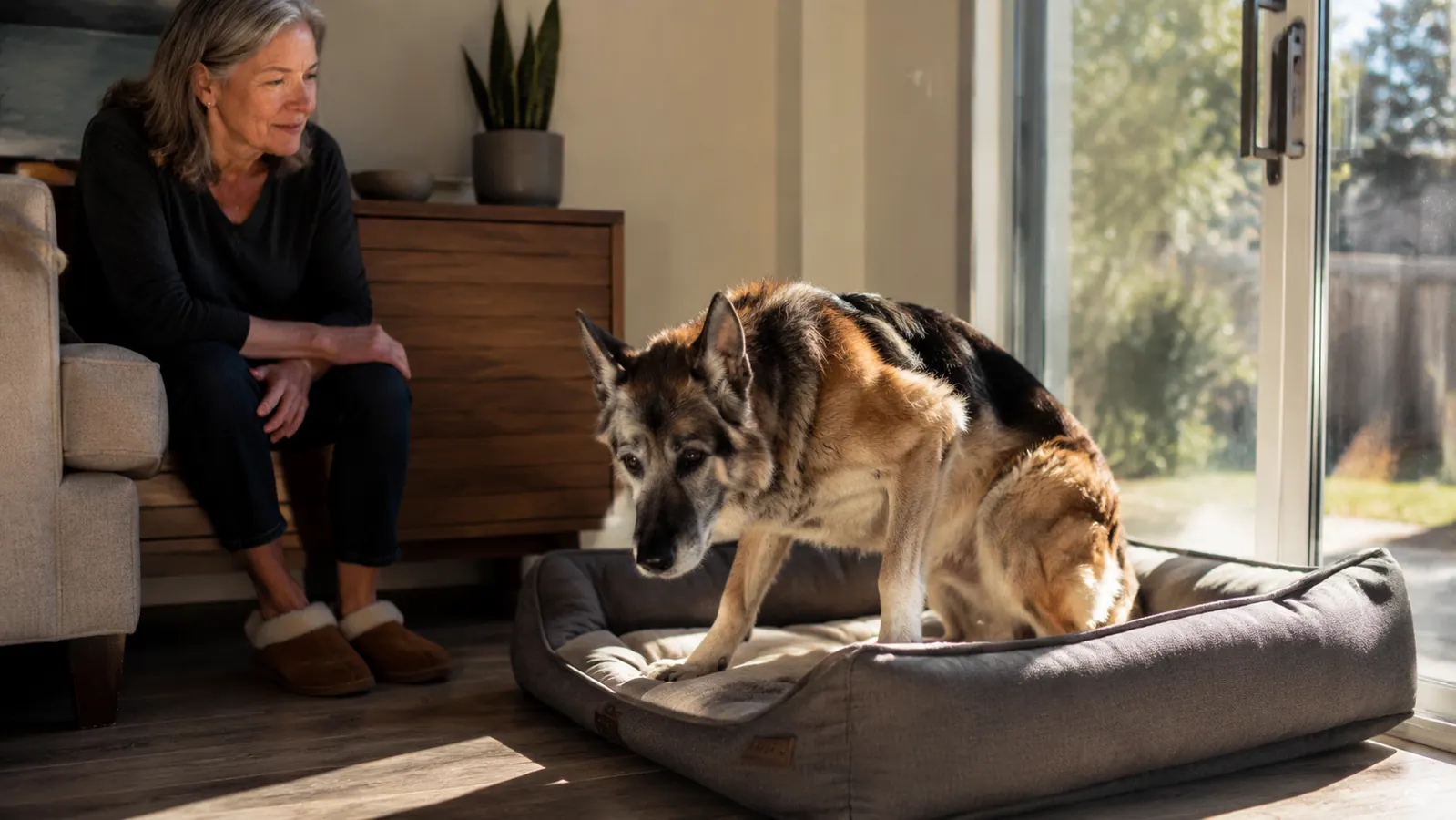
This bed is the right choice for owners of large and giant-breed dogs, particularly seniors or dogs with confirmed joint conditions like hip dysplasia, elbow dysplasia, or spondylosis. If your dog weighs between 60 and 120 pounds, has documented joint issues, and you want a waterproof orthopedic surface that will hold up for a year or more, this delivers on that promise at a price point that makes it accessible without feeling compromised. It is also a solid choice for dogs who are incontinent or prone to accidents, because the two-layer moisture protection is genuinely functional rather than marketing language.
If you are comparing this to the EHEYCIGA vs FurHaven options, read my detailed EHEYCIGA vs FurHaven comparison before deciding. Both have real strengths and the choice comes down to your dog's specific sleeping style and your priorities around foam density versus cover material softness.
Who Should Skip It
If your dog is a chewer, the outer cover's microplush fabric will not survive. This is not a criticism of EHEYCIGA specifically; no fabric-covered bed is chew-proof. Dogs who shred bedding need a chew-resistant bed with a canvas or ballistic nylon cover, which is a different product category entirely. Also, if you are looking for a bed for a small or medium dog under 40 pounds, the EHEYCIGA foam density may be more than you need, and you will be paying for support engineering that never gets used. Finally, if you need the foam to last more than two years under a very heavy dog (over 110 pounds), I would suggest budgeting up to a denser orthopedic foam option.
For a full framework on what to look for before buying, the guide on how to pick the right orthopedic dog bed for large breeds covers foam density, liner construction, and sizing in detail. That is worth reading if this is your first time buying in this category.
One year with a joint-compromised shepherd. The EHEYCIGA still gets used every night.
Atlas chooses this bed over the couch and over the hardwood floor, which is the most honest endorsement I can offer. If your large dog deserves a sleep surface that actually supports their joints through the night, this is the one I would buy again.
Amazon Check Today's Price on Amazon →